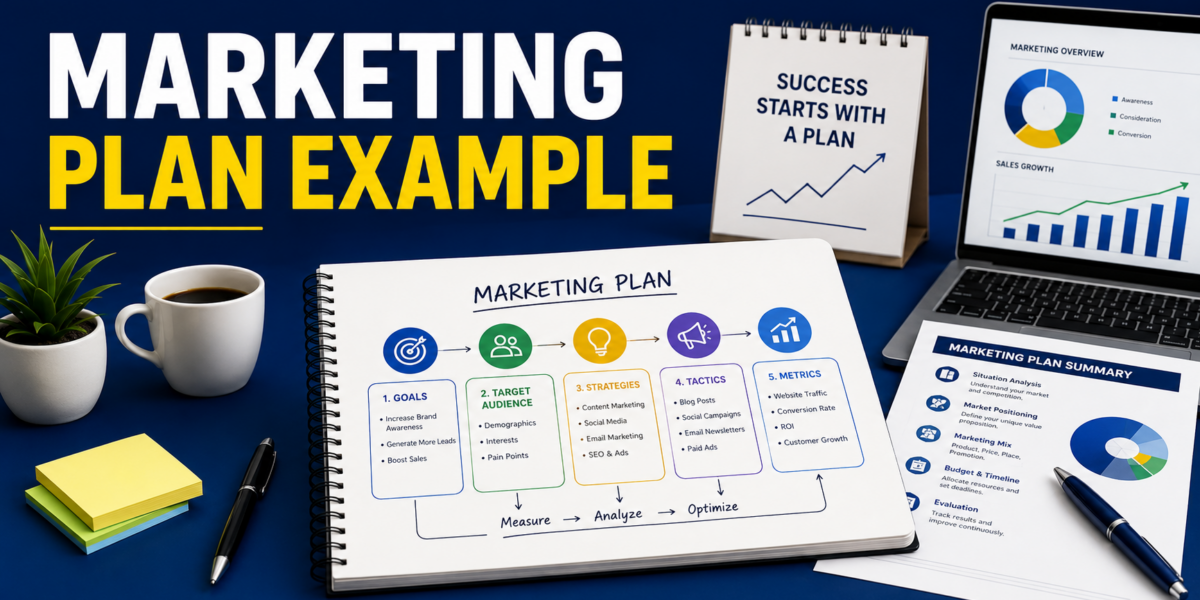
Most people searching for a marketing plan example are not looking for a definition, they already know roughly what a marketing plan is, what they actually want is to see one laid out in front of them so they can copy the structure and adapt it to their own business. The problem is that a marketing plan built for a growing SaaS company looks almost nothing like one built for a neighborhood restaurant, and grabbing a generic template rarely captures what actually matters for a specific type of business. Before building any plan, it also helps to be clear on the marketing fundamentals underneath it, since a plan is only as strong as the thinking that shaped it.
This guide walks through 7 marketing plan examples built for different types of businesses, showing what each one typically includes and why the structure differs so much from one to the next.
Small Business Marketing Plan Example
A small business marketing plan usually stays lean and practical, built around a handful of channels rather than a sprawling multi department strategy. A typical example starts with a short summary of the business and its main goal for the year, followed by a description of the target customer, three or four core marketing channels such as local SEO, social media, and email, a simple monthly content calendar, and a basic budget broken down by channel. What makes this version work is realism, it reflects what one or two people can actually execute consistently rather than a plan built for a team the business does not have, which is exactly the approach covered in a solid small business marketing agency guide.
Startup Marketing Plan Example
A startup marketing plan tends to center around one core question, how does this business find its first meaningful group of customers before it runs out of runway. A typical example includes a clear positioning statement explaining what makes the product different, a small set of early acquisition channels being tested simultaneously, specific metrics being tracked closely such as cost per signup, and a short section on what will be cut or doubled down on based on early results. What makes this version different is speed, startup plans are built to be revisited monthly or even weekly rather than sitting untouched for a year like a more traditional plan.
Ecommerce Marketing Plan Example
An ecommerce marketing plan is built almost entirely around the customer journey from discovery to purchase to repeat order. A typical example includes a breakdown of traffic sources such as organic search, paid ads, and email, a content plan built around product pages and buying guides, a promotional calendar tied to seasonal sales periods, and a retention section covering email flows for abandoned carts and repeat purchase offers. What makes this version distinct is its heavy reliance on data, ecommerce plans usually reference specific conversion rates and average order values because so much of the strategy depends on those numbers moving in the right direction.
Service Business Marketing Plan Example
A service business marketing plan, whether for a consultant, an agency, or a local provider, usually leans heavily on trust building rather than direct product promotion. A typical example includes a section on ideal client profiles, a content plan built around case studies and educational articles, a referral and partnership strategy since service businesses often grow through word of mouth, and a simple lead nurture sequence for prospects who are not ready to buy yet. This structure reflects the same trust first thinking found in strong content marketing for small business, where the goal is proving expertise before ever asking for the sale.
Nonprofit Marketing Plan Example
A nonprofit marketing plan differs from a typical business plan in that its main goal is rarely a direct sale, it usually centers on awareness, donations, or volunteer recruitment instead. A typical example includes a mission driven messaging section, a donor and volunteer persona breakdown, a content calendar built around storytelling and impact updates, and a campaign section tied to specific fundraising events or seasonal giving periods. What makes this version unique is its emotional core, nonprofit plans succeed or fail based on how well they connect a supporter’s values to the actual work being done.
Social Media Marketing Plan Example
A social media marketing plan focuses specifically on platform strategy rather than the full marketing mix, often existing as one section inside a larger plan or as its own standalone document for businesses leaning heavily on social channels. A typical example includes platform selection based on where the target audience actually spends time, a content pillar breakdown covering three or four recurring themes, a posting frequency and format plan, and a section on paid social boosting for top performing organic posts. This kind of plan connects naturally back to a broader content strategy since social content rarely performs well in isolation from everything else a business is publishing.
Product Launch Marketing Plan Example
A product launch marketing plan is built around a single event rather than ongoing activity, with a clear before, during, and after structure. A typical example includes a pre launch teaser phase to build anticipation, a launch day sequence across email, social, and any paid channels being used, an influencer or early adopter outreach section, and a post launch follow up plan to keep momentum going once the initial excitement fades. What sets this version apart is its time sensitivity, unlike most marketing plans built around a full year, a launch plan usually spans just a few weeks with a very specific deadline driving every decision.
How To Choose The Right Marketing Plan Structure
The table below compares these 7 examples across their primary focus and typical timeframe, since matching the structure to the actual business situation matters more than following any single template exactly.
| Plan Type | Primary Focus | Typical Timeframe |
|---|---|---|
| Small Business | Lean, practical execution | Ongoing, reviewed quarterly |
| Startup | Fast testing and iteration | Reviewed monthly or weekly |
| Ecommerce | Customer journey and conversion | Ongoing, tied to sales calendar |
| Service Business | Trust building and referrals | Ongoing, reviewed quarterly |
| Nonprofit | Awareness and donor relationships | Tied to campaigns and events |
| Social Media | Platform specific content strategy | Ongoing, reviewed monthly |
| Product Launch | Single event momentum | Weeks, not months |
Three Business Examples
A local dry cleaning business built a simple small business marketing plan covering just three channels, local SEO, a monthly email offer, and Google Business Profile updates, and found the plan actually got followed because it was short enough to revisit every week without feeling overwhelming.
A small ecommerce store built an ecommerce style plan around their busiest sales season, mapping out email flows and promotional content weeks in advance, which meant nothing had to be rushed together at the last minute once the sale actually launched.
An IT training institute used a service business style plan built around case studies from past graduates, using their outcomes as the core proof point across the whole marketing calendar instead of relying on generic promotional messaging.
Why Businesses Choose BizBoosted To Build A Marketing Plan
A template only gets a business so far, most plans fail not because the structure was wrong but because nobody adapted it to what that specific business could realistically execute. At BizBoosted, our team builds marketing plans around real capacity and real goals, grounded in the same research driven process behind our SEO strategy work, and connected to practical digital marketing services so the plan turns into action instead of sitting in a document nobody opens again.
Conclusion
A good marketing plan example is less about the exact template and more about matching the structure to what a specific business actually needs right now. A startup needs speed, an ecommerce store needs a strong grip on the customer journey, a service business needs proof and trust, and a nonprofit needs a story worth supporting. Pick the example closest to your own situation, adapt it honestly to what your team can actually execute, and revisit it often enough that it stays a living plan instead of a forgotten document.
You May also Love this
FAQs
What should a basic marketing plan include
A target audience, core channels, a content calendar, a budget, and clear goals to measure against.
How long should a marketing plan be
Short enough to actually get used, most small businesses do better with a few focused pages than a lengthy document.
How often should a marketing plan be updated
At least quarterly, sooner if results are clearly off track or a major business change happens.
Do startups need a different plan than small businesses
Yes, startup plans move faster and get revisited more often since early results shift the strategy quickly.
Can one marketing plan cover multiple business goals
Yes, but it should still prioritize clearly, trying to chase too many goals at once usually weakens all of them.
Is a marketing plan the same as a marketing strategy
Not quite, the strategy is the overall direction, the plan is the specific actions and schedule used to get there.