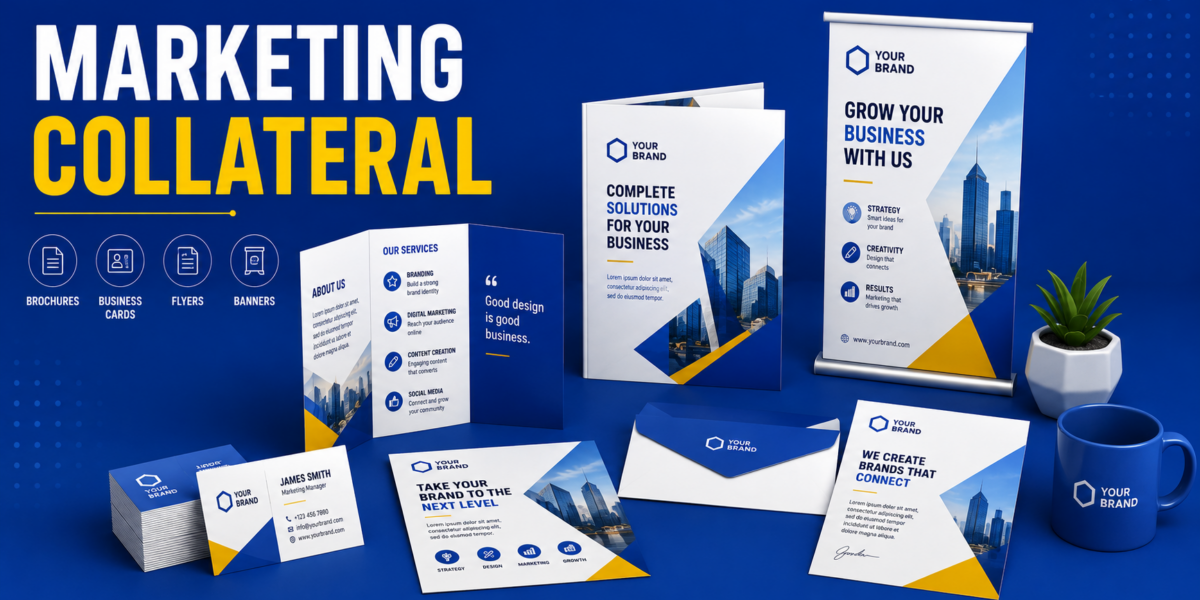
Walk into almost any small business and you will find a drawer full of marketing collateral nobody ever uses again, a stack of brochures printed two years ago, a sales deck built once and never updated, business cards ordered in bulk that half the team still has not touched. The problem was rarely the idea behind the material, it was usually that nobody matched the type of collateral to the moment it was actually needed. A brochure handed to a cold prospect does a completely different job than a case study sent to someone already deep in a buying decision, and treating every piece of marketing material the same way is exactly why so much of it ends up ignored. Good collateral connects directly back to the kind of content strategy a business already has in place, it should never feel like a separate project bolted on at the last minute.
This guide walks through 8 types of marketing collateral, what each one is genuinely good at, and where it tends to fall flat, so the next piece your business creates actually earns a place in someone’s hands or inbox instead of a drawer.
Brochures
A brochure is still one of the most recognizable forms of marketing collateral, a folded or printed piece that introduces a business, its offerings, and its value in a compact, portable format. What makes a brochure genuinely useful is context, it works best in person, at a trade show, in a waiting room, or handed over during a first conversation when someone wants something tangible to take away and think about later. Where it tends to fail is relevance, a brochure covering every single product or service a business offers usually ends up saying very little about any of them, and a visitor skims it once before it disappears into a bag or a bin.
Case Studies
A case study tells the story of a real client, the problem they faced, the approach taken, and the measurable result that followed, and it is arguably the most persuasive collateral a service business can create. What makes it work is proof, prospects trust a documented outcome from a real business far more than a general claim about quality or experience, which is exactly the kind of trust building that strong B2B content marketing depends on. Where it tends to fail is when it stays vague, a case study without specific numbers or a clear before and after picture reads more like a testimonial than actual evidence, and it loses most of its persuasive power.
One Pagers And Sell Sheets
A one pager, sometimes called a sell sheet, condenses a single product or service into one focused page covering the core benefits, pricing, and a clear next step. What makes it effective is speed, a busy decision maker can scan it in under a minute and immediately understand whether it is relevant to them, without wading through a full brochure covering unrelated offerings. Where it tends to fail is when a business tries to cram too much onto one page, defeating the entire purpose of a format built around quick, focused clarity.
Sales Decks
A sales deck is the presentation a sales team walks a prospect through, typically during a call or meeting, combining the pitch, supporting data, and a clear ask into a structured sequence of slides. What makes it work is narrative, a well built deck guides a prospect through a logical story rather than throwing every fact at them at once, building toward the moment they are asked to commit. Where it tends to fail is staleness, a deck built once and reused for years without updates starts referencing outdated pricing, old client logos, or offers that no longer exist, quietly undermining credibility in the room.
Whitepapers
A whitepaper is a longer, more research driven piece of collateral, typically used to establish authority on a complex topic rather than to sell directly. What makes it effective is depth, it gives a business room to demonstrate real expertise on a subject a prospect is actively researching, often in exchange for an email address that turns a download into a lead, tying naturally into a broader content marketing services approach built around genuinely useful long form content. Where it tends to fail is tone, a whitepaper that reads like a thinly disguised sales pitch loses the credibility that made the format worth creating in the first place.
Business Cards
A business card remains one of the smallest but most persistent pieces of marketing collateral, exchanged in person long after most other materials have gone fully digital. What makes it valuable is memorability, a well designed card gives someone a physical reminder of a conversation, and a QR code or clear website URL on it can bridge straight into digital channels afterward. Where it tends to fail is when it becomes an afterthought, a cluttered card with too much information crammed onto it, or a generic template, ends up forgotten just as quickly as it was handed over.
Email Newsletters
An email newsletter is ongoing collateral rather than a one time piece, sent on a recurring schedule to keep a business in front of an audience between actual purchase decisions. What makes it effective is consistency, showing up reliably in someone’s inbox with genuinely useful content builds familiarity long before that person is ready to buy, supporting the same fundamentals covered in content marketing for small business that focus on staying present over time rather than chasing a single conversion. Where it tends to fail is when every issue turns into a sales pitch, readers unsubscribe quickly once a newsletter stops offering anything beyond a constant ask to buy.
Video Collateral
Video collateral, whether a short explainer, a client testimonial on camera, or a product demo, has become one of the fastest growing categories because it communicates far more in far less time than a page of text ever could. What makes it powerful is trust, seeing and hearing a real person explain a product or share a genuine result carries a kind of credibility that written words alone struggle to match. Where it tends to fail is production value, a video that looks and sounds rushed can actually hurt credibility more than having no video at all, so it is worth doing well or not doing it yet.
How To Choose The Right Marketing Collateral
The table below compares these 8 types across where they fit best in the buying journey, since the biggest mistake most businesses make is using the wrong type at the wrong moment rather than picking a bad format altogether.
| Type | Best Stage | Format | Primary Goal |
|---|---|---|---|
| Brochures | First introduction | Print or PDF | General awareness |
| Case Studies | Late consideration | PDF or webpage | Proof and trust |
| One Pagers | Quick evaluation | Fast clarity | |
| Sales Decks | Live conversation | Slide presentation | Guided persuasion |
| Whitepapers | Early research | PDF, gated | Authority and leads |
| Business Cards | In person meeting | Physical card | Memorability |
| Email Newsletters | Ongoing relationship | Recurring email | Staying top of mind |
| Video Collateral | Any stage | Video | Trust through demonstration |
Getting this mix right usually comes back to a clear foundation, the kind laid out in solid marketing fundamentals, since collateral only works when it is built around a real understanding of who the audience is and what stage they are actually at.
Three Business Examples
A local dry cleaning business replaced a generic brochure with a simple one page flyer highlighting just three services and a clear seasonal offer, and noticed customers referenced it directly far more often than the old, cluttered version ever got mentioned.
A small ecommerce store built a short video testimonial featuring one of their happiest repeat customers, and started using it on the product page for their top selling item, where it consistently outperformed the plain text reviews already on the page.
An IT training institute created a one page sell sheet for their most popular course, cutting a ten minute conversation about pricing and outcomes down to something a prospective student could read and understand in under a minute.
Why Businesses Choose BizBoosted For Marketing Collateral
Creating a piece of collateral is only useful if it is built around the actual moment a prospect encounters it, otherwise even well designed material ends up in that same forgotten drawer. At BizBoosted, our team builds collateral as part of a connected digital marketing service, matched to where a specific audience actually is, which is the same thinking behind our small business marketing agency approach of building around real client situations rather than templated packages, and the same research driven process used across our B2B marketing work for clients selling to other businesses.
Conclusion
Marketing collateral only works when it matches the moment someone actually encounters it, a brochure for a first conversation, a case study for someone already comparing options, a one pager for a prospect short on time. Most businesses do not need more collateral, they need the right few pieces built with real intention instead of a drawer full of material nobody quite remembers creating. Start with whichever stage of the buying journey feels weakest right now, and build one genuinely strong piece for it before adding anything else.
You may read this
FAQs
What counts as marketing collateral
Any material used to support marketing or sales, from brochures and case studies to newsletters and videos.
Do small businesses really need all 8 types
No, most businesses only need two or three types well done rather than a little of everything done poorly.
Which type of collateral converts best
Case studies usually convert best for service businesses, since real proof tends to outweigh general claims.
Should collateral be print or digital
Digital fits most modern buying journeys, though print still has a place in person, like at events or meetings.
How often should marketing collateral be updated
At least once a year, or sooner if pricing, offers, or client examples become outdated.
Can one piece of collateral work for every stage of the buying journey
Rarely, most effective collateral is built for a specific moment rather than trying to do everything at once.



1 Comment