Google Ads Cost Explained
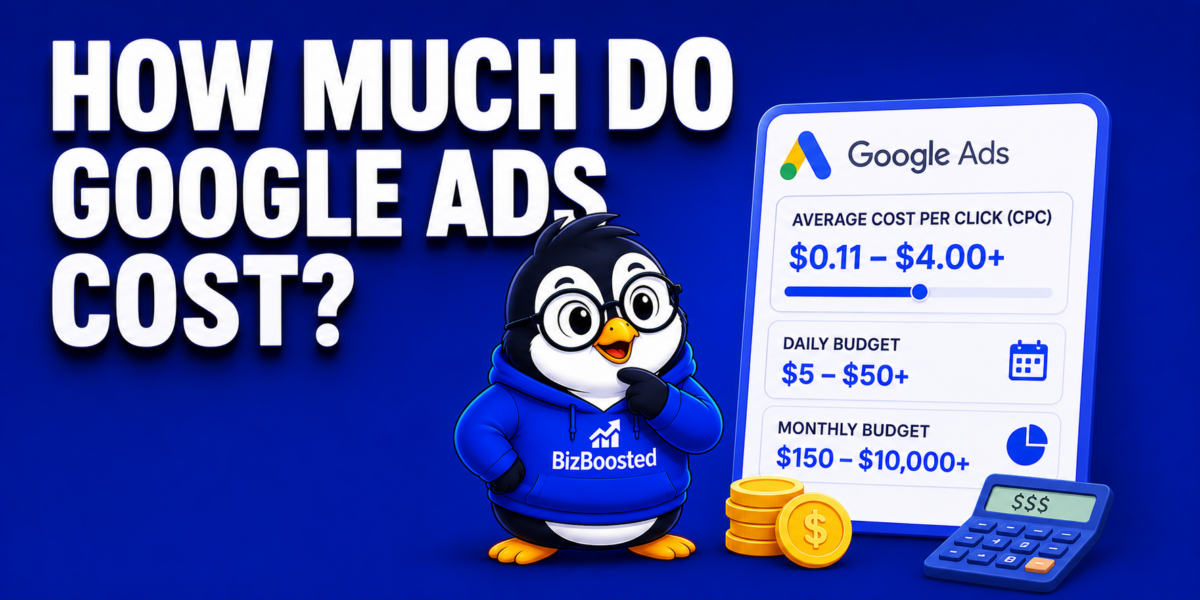
If you are thinking about running Google Ads, the first question is probably simple: how much will Google Ads cost? The answer is not one fixed price because Google Ads uses auctions, and the amount you pay can change depending on your keywords, competition, location, industry, targeting, bidding strategy, and the quality of your campaign. This is why two businesses can advertise similar services while seeing completely different costs per click and different returns from the same advertising platform.
A common mistake is to think that having a larger advertising budget automatically means getting better results. Your budget controls how much you can spend, but it does not guarantee profitable clicks, leads, or sales. A business can spend a small amount very efficiently, while another business can spend thousands without generating enough customers because its targeting, offer, landing page, or conversion tracking is weak. The real objective is therefore not simply to reduce advertising costs but to make every dollar work toward a valuable business outcome.
The easiest way to understand Google Ads Cost Explained is to separate the cost into several connected parts: your advertising budget, the auction and bid, cost per click, conversion cost, landing-page performance, and ultimately customer acquisition cost. Once these numbers are connected, you can determine whether your campaigns are actually affordable and profitable instead of judging performance from CPC alone.
How Much Does Google Ads Cost?
There is no universal Google Ads price. You decide how much you are willing to spend through your campaign budget, while the actual cost of advertising depends on the opportunities available in the auctions you enter. Google explains that advertisers can set budgets and bids, but the amount charged for a click can be lower than the maximum amount an advertiser is willing to pay.
For example, suppose you set a daily budget of $50. That does not mean every click will cost $50 or that you will automatically receive a specific number of clicks. If relevant clicks in your market cost $2 on average, the same budget could potentially generate far more clicks than if relevant clicks cost $10. Competition, search intent, location, device, industry, and other factors can influence the cost.
This is why businesses should avoid asking only, “What is the average Google Ads cost?” A more useful question is, “How much can I afford to pay to acquire one customer?” Once you know your customer value and acceptable acquisition cost, you can work backward to establish a realistic advertising budget.
What Determines Google Ads Cost?
Several factors influence how much you may pay for Google Ads. The most obvious is competition. If many advertisers are competing for the same high-value keyword, the auction can become more competitive. Commercial searches often attract advertisers because the person searching may be closer to making a purchase or contacting a business.
Your targeting also matters. A highly specific local campaign can behave very differently from a nationwide campaign. For example, a roofing company targeting one city may have a completely different auction environment from a national company targeting the entire country. Search demand, competitors, customer value, and geographic targeting can all affect campaign economics.
Your ad and landing-page relevance also matter. Google considers factors related to ad and landing-page quality when determining Ad Rank. This means a campaign should not be built around bids alone. Better alignment between the customer’s search, your advertisement, and your landing page can create a stronger advertising experience and help you compete more effectively.
Understanding Cost Per Click
Cost per click, commonly called CPC, is one of the most visible numbers inside a Google Ads account. It represents the amount you pay when someone clicks your advertisement under the applicable pricing model. However, CPC should never be evaluated in isolation.
Imagine Campaign A has an average CPC of $3 and generates 10 customers from 100 clicks. Campaign B has an average CPC of $1 and generates only one customer from the same number of clicks. Campaign B looks cheaper at first glance, but Campaign A may be significantly more valuable to the business.
| Metric | Campaign A | Campaign B |
|---|---|---|
| Clicks | 100 | 100 |
| Average CPC | $3 | $1 |
| Ad Spend | $300 | $100 |
| Customers | 10 | 1 |
| Cost per Customer | $30 | $100 |
This example shows why Google Ads Cost Explained should always include the entire customer journey. A cheaper click does not necessarily mean a cheaper customer.
CPC vs CPA vs Customer Acquisition Cost
Three numbers are particularly useful when evaluating paid advertising: CPC, CPA, and customer acquisition cost.
CPC tells you what you paid for a click. CPA, or cost per acquisition, tells you how much advertising spend was required to generate a defined conversion. Customer acquisition cost, or CAC, goes further by considering the cost of acquiring an actual customer rather than simply a tracked conversion.
For example, if you spend $500 and generate 20 leads, your average cost per lead is $25. But if only five of those leads become customers, your advertising cost per customer is $100. If the average customer generates $500 in gross profit, the campaign may be economically attractive. If the average customer generates only $50, the same advertising campaign could be unsustainable.
This is why experienced advertisers do not automatically optimize for the lowest CPC. They optimize toward valuable outcomes.
How Google Ads Bidding Affects Cost
Bidding determines how your campaign competes for available advertising opportunities. Google Ads offers multiple bidding strategies depending on your objective, including approaches focused on clicks, conversions, conversion value, visibility, and other goals.
For example, a business that wants website traffic may choose a click-focused approach, while a lead-generation business may prioritize conversions. An ecommerce company may care about conversion value because purchases can have different values.
Automated bidding can also use machine learning and contextual signals to adjust bids at auction time. However, automation does not mean you can ignore strategy. Your campaign still needs accurate conversion tracking, appropriate goals, relevant targeting, strong advertisements, and effective landing pages.
If your conversion tracking is incorrect, an automated strategy can optimize toward the wrong outcome. This is one of the most important principles when considering Google Ads Cost Explained: automation can optimize a goal, but you must make sure the goal is actually valuable to your business.
How Quality Can Influence Google Ads Cost
Google does not simply reward the advertiser willing to spend the most. Ad Rank considers multiple factors, including the bid, ad and landing-page quality, expected impact of assets, thresholds, search context, and competition.
This makes relevance extremely important. Suppose a user searches “emergency dentist near me.” One advertiser shows a generic ad for a dental clinic, while another uses messaging specifically related to emergency dental care and sends the visitor to a dedicated emergency-service page. The second experience is more closely aligned with the user’s search.
A strong campaign therefore connects three things:
Keyword or Search → Relevant Advertisement → Relevant Landing Page
When these elements are disconnected, you can end up paying for clicks that have little chance of becoming customers. Improving relevance is often more useful than immediately increasing your bid.
How Industry Affects Google Ads Cost
Different industries can have dramatically different advertising economics because customer values and competition vary. A business selling an inexpensive product may not be able to justify the same acquisition cost as a business selling a high-value professional service.
Consider a consultant who earns thousands of dollars from one client. Paying $100 for a qualified lead could potentially make sense if a reasonable percentage of leads become customers. A small ecommerce store selling a $30 product has a very different calculation because the advertising cost must fit within its margins.
This is why industry-wide CPC averages should be treated carefully. Even when an average number is available, it may not tell you whether that cost is profitable for your particular business.
How Location Changes Advertising Costs
Location can significantly affect campaign economics because different markets have different levels of demand and competition. A local campaign targeting one city may face a completely different auction environment from a national campaign.
For example, a cleaning company serving one metropolitan area should not necessarily advertise across an entire country. Broad targeting can expose the campaign to people who cannot use the service, wasting budget and reducing data quality.
Location targeting should therefore reflect where your actual customers can buy from you. Service-area businesses, local stores, consultants, and regional companies can often benefit from carefully defining their geographic targeting instead of paying for irrelevant traffic.
Businesses working on local visibility can also connect paid campaigns with local SEO for small businesses so that paid and organic visibility support the same geographic customer journey.
How Landing Pages Affect Your Advertising Budget
Imagine spending $1,000 to generate highly relevant traffic and then sending those visitors to a confusing website. Your advertising campaign may be doing its job by attracting the right people, but the website is failing to convert them.
A landing page should match the advertisement, explain the offer quickly, remove common objections, demonstrate credibility, and make the next action obvious. For a service business, this could mean a strong call button, enquiry form, testimonials, service details, and clear location information.
For ecommerce, the page should make the product, price, benefits, shipping information, reviews, and purchase action easy to understand. Improving the post-click experience can help you get more value from the traffic you are already paying for.
How Conversion Rate Changes Google Ads Cost
Conversion rate has a direct relationship with the economics of your advertising campaign. If more qualified visitors convert after clicking your ads, the same advertising spend can produce more leads or sales.
For example, suppose you spend $1,000 and generate 500 clicks. If 2% convert, you receive 10 conversions. If improvements increase the conversion rate to 4%, you receive 20 conversions from the same 500 clicks.
| Conversion Rate | Clicks | Conversions | Spend | Cost per Conversion |
| 2% | 500 | 10 | $1,000 | $100 |
| 4% | 500 | 20 | $1,000 | $50 |
| 6% | 500 | 30 | $1,000 | $33.33 |
This is why improving the landing page and offer can sometimes be more powerful than simply trying to reduce CPC. If you double the number of conversions from the same traffic, your effective acquisition cost can fall substantially.
Google Ads Budget Planning
Your budget should start with your business goals rather than an arbitrary number. First estimate how many customers you want, how many qualified leads you need to generate those customers, and how much you can reasonably afford to acquire each customer.
For example, if a business wants 20 new customers and expects one customer for every five qualified leads, it needs approximately 100 qualified leads. If the acceptable cost per lead is $20, the estimated advertising budget would be around $2,000.
This is only a planning framework, not a guarantee. Actual results depend on traffic quality, competition, conversion rates, sales performance, and many other variables. However, working backward from the desired business outcome provides a much stronger starting point than choosing a budget randomly.
Google Ads Cost for Small Businesses
Small businesses often worry that Google Ads is only suitable for companies with large advertising budgets. In reality, the bigger issue is whether the campaign is structured around realistic economics. A small business can still use paid search strategically if it focuses on relevant customers and avoids unnecessary traffic.
For example, a local electrician may not need to target every electrical-related search. It could focus on high-intent services such as emergency repairs, panel upgrades, or specific installation services in its service area. This can make a limited budget more focused.
The key is to start with a manageable campaign, establish reliable conversion tracking, understand the actual cost of acquiring customers, and then scale when the economics support additional spending.
Common Mistakes That Increase Google Ads Costs
One of the most expensive mistakes is targeting irrelevant searches. Broad keywords can attract users who are researching, looking for jobs, seeking free information, or searching for something your business does not provide. Regular search-term analysis can help identify unwanted traffic and improve targeting.
Another mistake is sending every advertisement to the same generic page. A person searching for a specific service should ideally see information that directly addresses that service. If they have to navigate around your website after clicking an ad, you are creating unnecessary friction.
Ignoring conversion tracking is another major problem. Without reliable data, you may increase spending on campaigns that generate clicks but not customers. Before scaling, verify that the actions you care about are being measured correctly.
| Costly Mistake | Better Solution |
| Targeting everything | Focus on relevant intent |
| Chasing cheap clicks | Measure profitable outcomes |
| Generic landing pages | Match pages to search intent |
| No conversion tracking | Track valuable actions |
| Increasing bids blindly | Diagnose the problem first |
| Ignoring customer value | Calculate acceptable CAC |
How to Reduce Wasted Google Ads Spend
Reducing wasted spend does not necessarily mean choosing the lowest possible CPC. Instead, focus on eliminating traffic that has little chance of becoming a customer. Review search terms, locations, devices, audiences, advertisements, and landing pages to identify where the budget is being consumed without meaningful results.
Negative keywords can also help prevent advertisements from appearing for searches that are clearly irrelevant. However, negative keyword management should be handled carefully because overly aggressive exclusions can remove potentially valuable searches.
You should also review the relationship between advertising and your broader marketing strategy. A visitor who does not convert immediately may still need additional content, trust signals, remarketing, or another touchpoint before becoming a customer. Your content marketing for small business strategy can support this longer customer journey.
Google Ads vs SEO Cost
Google Ads and SEO require different types of investment. With Google Ads, you pay for advertising opportunities according to your campaign and auction environment. With SEO, businesses generally invest in content, technical improvements, authority, optimization, and other activities designed to improve organic visibility.
Neither channel is automatically cheaper because the business outcome matters more than the initial traffic cost. Paid advertising can provide direct access to relevant searches, while SEO can build organic visibility that does not require paying for each organic click.
For businesses looking at both channels, SEO marketing services can help place paid search within a wider search visibility strategy.
When Is Google Ads Worth the Cost?
Google Ads can be worth the cost when the campaign consistently generates customers or valuable conversions at an acquisition cost that makes financial sense for the business. The important number is not simply how much you spend but what you receive in return.
If your average customer generates $1,000 in profit and your advertising campaign reliably acquires customers for $150, the campaign may have room to scale. If you spend $150 to acquire a customer who generates only $100 in profit, increasing the budget is unlikely to solve the underlying problem.
This is why Google Ads Cost Explained should always end with profitability rather than CPC. Before increasing your budget, understand your conversion rate, cost per conversion, customer acquisition cost, customer value, and profit margin.
A Simple Google Ads Cost Framework
Use this framework before launching or scaling a campaign:
Monthly Goal → Required Customers → Required Leads → Conversion Rate → Expected Clicks → Estimated CPC → Advertising Budget
Then review the results:
Ad Spend → Leads/Sales → Qualified Customers → Revenue → Profit
If the final numbers work, you have a foundation for scaling. If they do not, identify the weakest stage rather than simply spending more.
For businesses that want professional support with paid search, a dedicated Google Ads management agency can help with campaign structure, keyword targeting, bidding, conversion tracking, landing pages, and ongoing optimization. The goal should always be better business performance rather than simply increasing advertising activity.
Conclusion
Google Ads Cost Explained is not simply a question of how much a click costs; it is about understanding how your advertising spend turns into leads, customers, revenue, and profit. Your industry, competition, targeting, bidding, ad relevance, landing page, conversion rate, and customer value all influence the real economics of a campaign. Instead of chasing the cheapest clicks, focus on attracting the right people and measuring valuable outcomes. Before increasing your Google Ads budget, calculate your acceptable customer acquisition cost, fix wasted spend, improve conversion performance, and scale only when the numbers make business sense.
You May Read This
FAQs
How much does Google Ads cost?
There is no fixed price. Your cost depends on competition, keywords, location, bidding, targeting, and campaign performance.
What is the average Google Ads cost per click?
There is no universal CPC because costs vary significantly by industry, keyword, location, competition, and search intent.
Can I set my own Google Ads budget?
Yes. Advertisers can establish campaign budgets, but actual performance and traffic volume depend on available advertising opportunities and campaign settings.
Is Google Ads worth it for small businesses?
It can be, especially when the business targets relevant high-intent searches and can accurately measure valuable conversions.
How can I reduce Google Ads costs?
Focus on relevant searches, improve ad and landing-page relevance, remove wasted traffic, monitor search terms, and optimize toward valuable conversions rather than cheap clicks.
Is Google Ads cheaper than SEO?
Not necessarily. They use different investment models, and the better option depends on your goals, competition, customer value, and expected return.

1 Comment