How Google Ads Work
Have you ever searched Google for a product or service and noticed certain businesses appearing above the organic results? Those businesses are often using Google Ads to reach potential customers at the exact moment they are searching. But how Google Ads work is more than simply paying Google to appear at the top. Advertisers compete in an automated auction, and Google considers factors such as the bid, ad relevance, landing page experience, search context, and expected impact of the advertisement when deciding which ads can appear.
For businesses, this creates a major opportunity but also a major risk. A well-planned campaign can put your offer in front of people with strong buying intent, while a poorly structured campaign can consume your budget without producing meaningful customers. The difference usually comes down to strategy: choosing the right searches, matching the advertisement to user intent, sending visitors to the right landing page, tracking conversions correctly, and continuously improving the campaign based on real performance data.
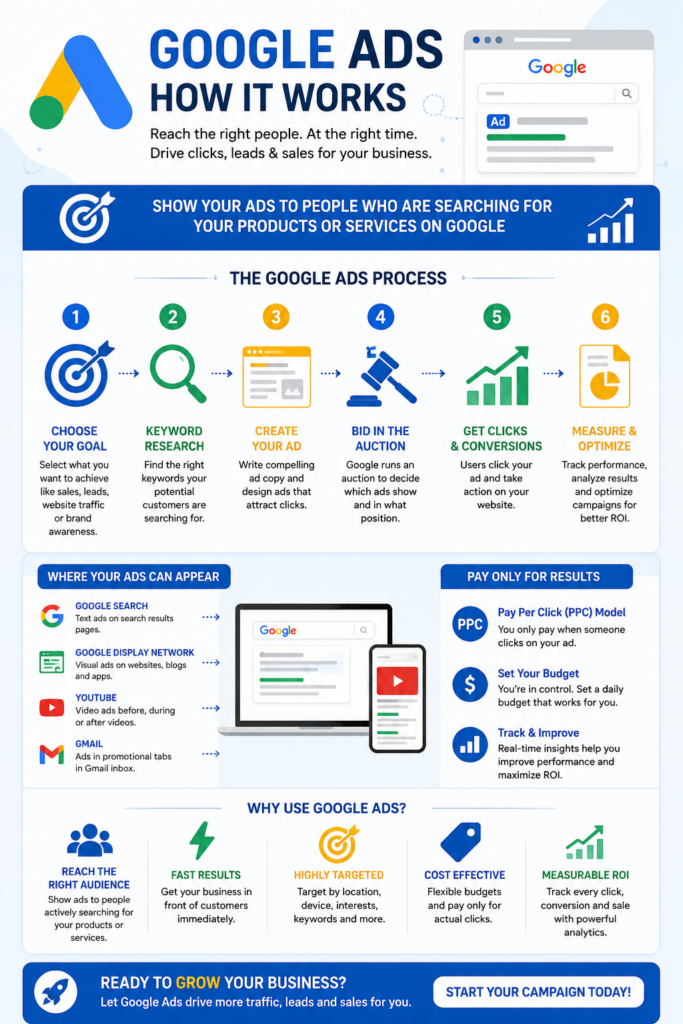
The easiest way to understand the entire process is to think of Google Ads as a customer journey: search → auction → ad → click → landing page → conversion → optimization. Every stage matters. If your targeting is wrong, you attract the wrong visitors. If your ad is weak, people may ignore it. If your landing page is confusing, clicks may not become leads or sales. And if conversion tracking is inaccurate, you may optimize the campaign based on misleading information.
What Are Google Ads?
Google Ads is Google’s advertising platform that allows businesses to promote products, services, websites, apps, and offers across Google’s advertising network. Search ads are one of the most recognizable formats because they can appear when people search for products, services, answers, or businesses. Other campaign types can reach people through different Google properties and advertising placements depending on the advertiser’s objective.
The important thing to understand is that Google Ads does not work like a simple billboard where the advertiser pays a fixed amount for a guaranteed position. For Search advertising, eligible ads compete in an auction whenever an advertising opportunity occurs. Google evaluates the eligible advertisements and determines which ads can appear and their relative positions. This means advertisers need more than a large budget; they need relevant targeting, useful messaging, and a strong customer experience.
This is particularly important for small businesses. A company with a limited budget should not try to compete for every possible search. Instead, it should focus its budget on searches that closely connect with its products, services, location, and ideal customer. A focused campaign can be easier to manage and optimize than a campaign that tries to reach everyone.
How Google Ads Work Step by Step
Understanding how Google Ads work becomes much easier when you follow what happens after a person performs a search. Imagine someone searches for “emergency plumber near me.” Google identifies advertisements that may be relevant to that search based on the advertisers’ targeting and campaign settings. Eligible ads then enter the auction, where Google determines which ads can appear and their positions.
The advertiser’s bid is important, but it is not the only factor. Google also considers ad and landing page quality, expected impact from assets, the context of the search, competition, and other auction-related factors. This is why simply increasing your bid is not always the best way to improve performance. If your ad does not closely match the search or your landing page does not satisfy the visitor, increasing your budget may simply increase the amount you spend.
After the advertisement appears, the user decides whether to click. If they click, they reach your landing page, where the next part of the customer journey begins. The page should immediately confirm that the visitor is in the right place, explain the offer clearly, build trust, and make the desired action simple. That action could be a purchase, phone call, form submission, booking, quote request, or signup.
The complete process looks like this:
Customer Search → Ad Eligibility → Auction → Ad Position → Click → Landing Page → Conversion → Data → Optimization
This last stage is often ignored by beginners. Launching a campaign is not the finish line. Once the campaign begins collecting data, you should evaluate which searches, ads, audiences, landing pages, and conversion actions are producing meaningful business results.
How the Google Ads Auction Works
The Google Ads auction happens whenever an advertising opportunity is available. Google determines which eligible ads can participate and evaluates them using Ad Rank and other auction factors. The auction is designed to consider more than just the advertiser willing to bid the most, which means relevance and quality can play an important role in determining visibility.
For example, imagine two businesses selling the same service. Business A bids aggressively but uses a generic advertisement that sends users to its homepage. Business B has a highly relevant advertisement that directly addresses the search and sends users to a dedicated service page. Even if Business B does not have the largest budget, its stronger alignment may help it compete more effectively.
This is one of the most important lessons when learning how Google Ads work: more money does not automatically equal better advertising performance. Your budget determines how much opportunity you can pursue, but campaign quality determines how effectively those opportunities can be turned into useful traffic and conversions.
What Is Ad Rank?
Ad Rank helps Google determine whether an ad is eligible to show and where it may appear compared with other eligible advertisements. Google considers several factors when determining Ad Rank, including the bid, ad and landing page quality, expected impact of assets, minimum thresholds, search context, and competition.
This means advertisers should not treat their bid as the entire campaign strategy. If an ad has poor relevance, unclear messaging, or a weak landing page, simply raising the bid may not solve the underlying problem. A better approach is to first diagnose why the campaign is underperforming.
Quality should therefore be considered from the customer’s perspective. Does the advertisement answer the search? Does the landing page provide what the ad promised? Can the visitor immediately understand what to do next? When these elements work together, the advertising experience becomes more useful and easier to optimize.
How Keywords Work in Google Ads
Keywords help advertisers communicate which types of searches are relevant to their products or services. However, successful keyword strategy is not about collecting as many keywords as possible. It is about understanding what people actually mean when they search.
Consider these searches:
| Search | Likely Intent |
|---|---|
| what is google ads | Informational |
| how google ads work | Informational |
| google ads management agency | Commercial |
| hire google ads expert | Transactional |
| google ads management pricing | Commercial |
All of these searches relate to Google Ads, but they do not represent the same level of buying intent. Someone researching what Google Ads are may not be ready to hire an agency. Someone searching for a Google Ads management agency is much closer to making a commercial decision.
Your keyword research guide can support this process by helping you understand keyword opportunities before building a campaign. The goal is to organize keywords around relevance and intent rather than simply chasing search volume.
Why Search Intent Matters
Search intent is the reason behind a search. It is one of the most important concepts in how Google Ads work because the same topic can contain searches from people at completely different stages of the buying journey.
For example, a person searching “best accounting software for small business” is probably comparing options. Someone searching “accounting software pricing” may be closer to evaluating a purchase. Someone searching “buy accounting software” has an even clearer transactional intent.
If you put all these searches into one strategy without understanding the difference, your campaign can become difficult to optimize. Your search intent guide can help you separate informational, commercial, and transactional searches so your advertising messages are better aligned with what users actually want.
How Google Ads Bidding Works
Bidding determines how your campaign competes for available advertising opportunities. Google Ads provides different bidding approaches depending on campaign objectives, and automated bidding can use signals and historical performance to help optimize bids toward selected goals.
For example, a business focused on generating leads may want to optimize around conversions instead of simply maximizing clicks. An ecommerce company may care more about conversion value because one purchase could be worth significantly more than another. The correct approach depends on the business model, conversion data, sales process, and profitability.
The biggest mistake is choosing a bidding strategy simply because it sounds advanced. Your bidding strategy should support your actual business goal. If your goal is qualified leads but you only measure clicks, the campaign may optimize around activity instead of meaningful outcomes.
Why Conversion Tracking Matters
Conversion tracking tells you whether people who interact with your advertisements complete valuable actions. Without reliable conversion tracking, you may know how many people clicked but not whether those visitors became customers.
Imagine a local marketing agency receives 100 clicks and 15 contact-form submissions. That information sounds positive, but what if only two submissions become qualified leads? Looking only at the number of forms could lead the advertiser to make poor decisions about where to spend money.
A stronger setup connects advertising activity with actual business outcomes. Track actions such as purchases, calls, qualified enquiries, bookings, or other meaningful events. The more accurately you measure value, the more confidently you can decide which campaigns deserve additional budget.
How Landing Pages Affect Google Ads
Your advertisement creates an expectation, while your landing page needs to fulfill it. If someone searches for “emergency roof repair,” clicks an advertisement promising emergency service, and lands on a generic homepage, they may immediately leave because the page does not make the next step obvious.
A strong landing page should match the search intent, clearly communicate the offer, provide relevant information, establish trust, and make conversion easy. The page should not force visitors to search through your website to find what the advertisement already promised.
This is where paid advertising and SEO principles overlap. Strong page structure, relevant content, clear messaging, and useful metadata can support a better overall search experience. You can also use BizBoosted’s meta title generator and meta description generator as supporting tools when optimizing important website pages.
Real-World Google Ads Examples
Example 1: Local Plumber
Imagine a plumber advertising several services but sending every visitor to one homepage. The campaign receives clicks, but the business cannot determine which services generate the best leads. A better approach would separate services such as emergency plumbing, drain cleaning, and water heater repair, with relevant advertisements and dedicated landing pages for each service.
The benefit is not simply better organization. The business can understand which searches generate valuable enquiries and then allocate its budget toward the strongest opportunities. If emergency plumbing produces higher-value calls, the campaign can be optimized around that customer demand rather than treating every click equally.
Example 2: Ecommerce Store
An ecommerce store selling hundreds of products may have different customer groups and different product values. A visitor searching for a specific product is usually much closer to a purchase than someone searching for general product information.
The retailer can structure campaigns around product relevance and measure purchases and conversion value. Instead of focusing only on traffic, it can evaluate which products and campaigns contribute meaningful revenue.
Example 3: B2B Software Company
A B2B software company may receive many leads from broad searches but discover that only a small portion become qualified sales opportunities. In this situation, increasing the number of leads is not necessarily the answer.
The company can improve its targeting, messaging, landing pages, and conversion definitions so advertising data better reflects business value. Its broader B2B marketing strategy can then support paid campaigns through content and lead nurturing.
Common Google Ads Mistakes
One of the biggest mistakes is launching a campaign without defining what success actually means. If you do not know whether you want sales, qualified leads, calls, bookings, or another specific action, it becomes difficult to evaluate performance. Another common mistake is targeting overly broad searches simply because they have high search volume, which can attract users who are not genuinely interested in your offer.
Sending all traffic to the homepage is another problem. A visitor who clicks an advertisement for a specific service should not have to search through your website to find that service again. Similarly, advertisers often increase bids before checking whether the actual problem is poor relevance, weak messaging, inaccurate conversion tracking, or a poor landing page.
| Mistake | Better Approach |
| Chasing clicks | Measure meaningful conversions |
| Broad targeting | Focus on relevant intent |
| Generic landing pages | Match pages to advertisements |
| Ignoring search terms | Review traffic quality |
| Increasing bids immediately | Diagnose the real problem |
| Tracking only leads | Evaluate lead quality |
| Changing everything at once | Optimize systematically |
How to Improve Google Ads Performance
Start with the customer rather than the advertising dashboard. Identify who you want to attract, what they are searching for, what problem they need solved, and what action you want them to take. Then create a campaign structure that connects those needs with relevant keywords, advertisements, and landing pages.
Next, review the complete customer journey. If impressions are low, investigate targeting and eligibility. If impressions are high but clicks are weak, review the advertisement and search relevance. If clicks are strong but conversions are poor, investigate the landing page, offer, trust signals, and conversion process.
Finally, evaluate business outcomes instead of surface-level metrics. Clicks and impressions are useful diagnostic numbers, but they do not automatically represent revenue. A campaign generating fewer clicks can be more valuable if those clicks produce better customers.
For businesses that need help connecting paid advertising with a broader growth strategy, digital marketing services can provide a broader framework covering paid advertising, SEO, content, social media, and other acquisition channels.
Google Ads vs SEO
Google Ads and SEO both help businesses reach people through Google, but they operate differently. Google Ads provides paid visibility through advertising auctions, while SEO focuses on improving organic search visibility. Paid advertising can provide immediate opportunities to reach relevant searches, while SEO is generally focused on building sustainable organic visibility over time.
The two channels can work together rather than competing against each other. Google Ads data can reveal valuable commercial searches that deserve organic content, while SEO can capture users who prefer organic results. Businesses should decide how much to invest in each channel based on their goals, competition, customer journey, and economics.
For a broader organic strategy, explore SEO marketing services and consider how paid search can complement long-term organic visibility.
When Should a Small Business Use Google Ads?
Google Ads can be useful when people are actively searching for the products or services a business provides and the business has a clear way to measure valuable actions. Local services, ecommerce stores, professional services, and B2B businesses can all potentially benefit, but the economics are different for every industry.
Before launching, determine your target customer, offer, search intent, conversion action, landing page, and acceptable acquisition cost. If these fundamentals are unclear, increasing advertising spend may create more problems instead of more customers.
A smaller business does not necessarily need to compete for every keyword. In many cases, a focused strategy built around high-intent searches can make more sense than trying to capture a huge amount of low-intent traffic.
Conclusion
Understanding how Google Ads work means looking beyond clicks and bids and understanding the complete customer journey from search to conversion. Successful campaigns connect the right search intent with relevant advertisements, focused landing pages, accurate conversion tracking, and continuous optimization. Instead of increasing your budget whenever performance drops, identify the real bottleneck first and fix the weakest part of the funnel. If your Google Ads campaigns are generating traffic but not enough customers, the next step is to review your targeting, messaging, landing pages, and conversion data before spending more.
You May Read This
FAQs
How Google Ads work for beginners?
Google Ads allows businesses to compete for advertising opportunities by choosing targeting, creating ads, setting budgets, and measuring conversions. Ads are selected through automated auctions.
Does Google Ads guarantee the top position?
No. Bidding is only one factor. Google also considers relevance, ad quality, landing page experience, search context, competition, and other auction factors.
How much do Google Ads cost?
There is no fixed price. Costs vary based on competition, targeting, bidding, search context, and the value advertisers place on each opportunity.
Is Google Ads better than SEO?
Neither is automatically better. Google Ads provides paid visibility, while SEO focuses on organic visibility. Many businesses benefit from using both strategically.
What is Ad Rank?
Ad Rank helps determine whether an advertisement can show and where it may appear compared with other eligible advertisements.
Why is conversion tracking important?
Conversion tracking shows which advertising interactions produce valuable actions such as sales, calls, bookings, or qualified leads.

1 Comment