What Is Google Ads Quality Score?
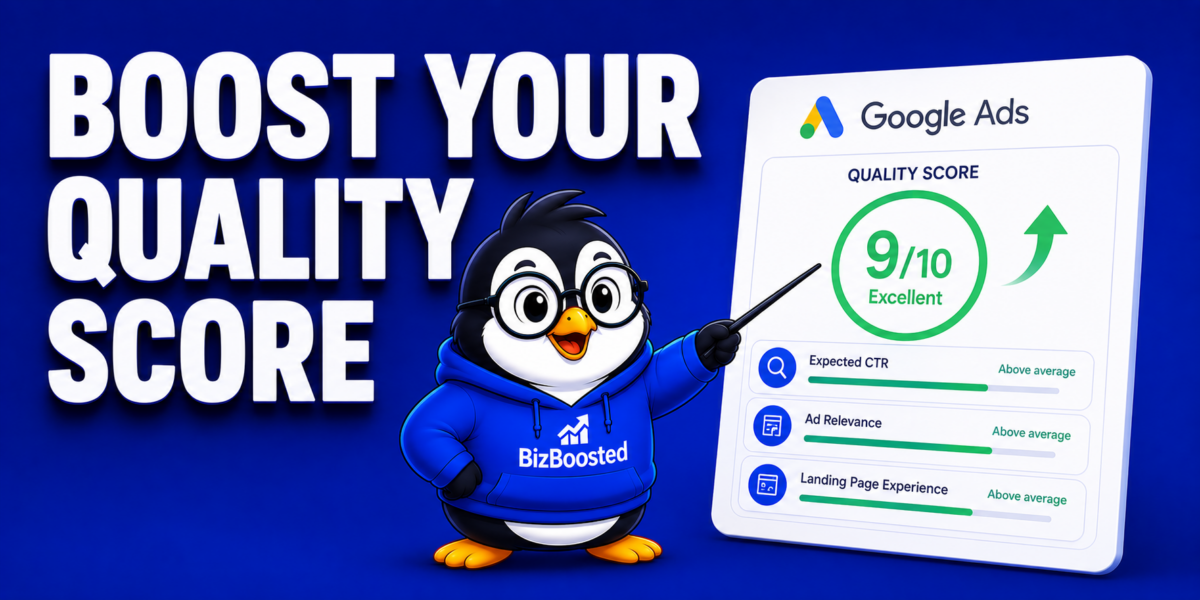
If your Google Ads campaign is getting expensive clicks, weak visibility, or fewer conversions than expected, your Google Ads Quality Score may deserve attention. Quality Score is a diagnostic metric in Google Ads that helps advertisers understand how relevant and useful their Search ads are compared with other advertisers. It is reported on a 1–10 scale at the keyword level and is based on historical performance and three main components: expected click-through rate, ad relevance, and landing page experience.
However, one important distinction is often misunderstood: Quality Score itself is not a direct input into the ad auction. Google describes it as a diagnostic tool that can help advertisers identify areas where their ads and landing pages may need improvement. The actual auction uses broader signals related to ad quality, relevance, landing page experience, bid, search context, and other factors. Understanding this difference prevents advertisers from chasing a perfect score while ignoring the metrics that actually matter to the business.
The practical goal should therefore not be “get every keyword to 10/10.” Instead, use the score to identify weaknesses in your campaign, improve the connection between search intent, advertisement, and landing page, and then measure whether those improvements produce better clicks, conversions, and business results.
Why Google Ads Quality Score Matters
A strong Quality Score can provide useful insight into how well your keywords, ads, and landing pages are aligned. When users search for something specific, Google wants to show advertisements that are likely to be relevant and useful. If your campaign consistently provides a poor experience, you may have difficulty competing efficiently for valuable searches.
Think about a person searching for “emergency plumber near me.” An advertisement that specifically addresses emergency plumbing and sends the user to a dedicated emergency-service page is more aligned with the search than an advertisement for a general home-services company that sends visitors to its homepage.
This relationship matters because paid search works best when the entire journey is connected. Your keyword or search theme identifies the need, your advertisement responds to that need, and your landing page provides the promised solution. Your search intent guide can help you understand this connection before restructuring your campaigns.
How Google Ads Quality Score Is Calculated
Google identifies three primary components behind the Quality Score diagnostic:
| Component | What It Tells You |
|---|---|
| Expected CTR | How likely your ad is expected to receive a click |
| Ad Relevance | How closely your advertisement matches the user’s search |
| Landing Page Experience | How relevant and useful the landing page is after the click |
Each component can be reported as Below Average, Average, or Above Average. These indicators are more useful for optimization than obsessing over the overall 1–10 number.
For example, imagine a keyword has a Quality Score of 5/10. If the landing page experience is marked Below Average while expected CTR and ad relevance are Average, the solution is not automatically to rewrite the entire campaign. The more logical first step is to investigate the landing page and determine why visitors may not be getting a sufficiently relevant or useful experience.
Expected Click-Through Rate
Expected click-through rate estimates how likely your ad is to receive a click when shown for a particular keyword, while considering the ad’s position. Google evaluates historical performance and other relevant signals when generating this diagnostic.
A low expected CTR can indicate that your advertisement is not compelling enough for the search intent or that the keyword is not well matched to the audience you are targeting. However, you should not respond by writing exaggerated advertisements just to increase clicks. A high CTR is not useful if the clicks come from people who are unlikely to become customers.
For example, suppose a company sells premium accounting software. An advertisement promising “Free Accounting Software” might attract many clicks if the offer is not actually free, but those clicks are unlikely to become valuable customers and may create a poor user experience. A better advertisement clearly communicates the actual value of the product and matches the user’s expectations.
The objective is qualified clicks, not clicks at any cost.
Ad Relevance
Ad relevance measures how closely the content of your advertisement relates to the keyword and searcher’s intent. If your ad is too broad, the user may not immediately recognize that your business provides exactly what they are looking for.
Imagine a business offering three services: residential roofing, commercial roofing, and emergency roof repair. Creating one generic advertisement for every roofing-related keyword may reduce relevance. Separating closely related themes and creating advertisements that directly address each service can create a clearer connection.
This is where strong keyword organization becomes important. Instead of putting hundreds of unrelated keywords into one group, organize terms according to meaningful themes and intent. Your keyword research guide can support this process by helping you identify relevant search terms before creating campaign structures.
Landing Page Experience
Landing page experience evaluates how relevant and useful the page is after someone clicks your advertisement. Google considers factors related to the page’s relevance and usefulness to the user, and advertisers should focus on creating a clear, helpful post-click experience.
Suppose your advertisement says “Emergency AC Repair — Call Today,” but the visitor lands on a page that only contains a general company introduction and a list of unrelated services. The visitor now has to search for the information they were promised. That creates unnecessary friction.
A stronger landing page would immediately explain the emergency repair service, identify the service area, provide relevant trust information, show the next step, and make contacting the business easy. The advertisement and landing page should feel like two connected parts of the same customer journey rather than separate pieces of content.
Google Ads Quality Score vs Ad Rank
These two concepts are often confused, but they are not the same thing.
Quality Score is a keyword-level diagnostic tool designed to help advertisers understand areas such as expected CTR, ad relevance, and landing page experience. Ad Rank, on the other hand, is used in the ad auction to determine whether an advertisement can show and where it can appear.
Ad Rank considers multiple factors, including bid, ad and landing-page quality, expected impact of assets, thresholds, search context, and competition. This means you should not assume that a keyword with a Quality Score of 10 will automatically appear above a competitor with a Quality Score of 7.
The better approach is to use Quality Score as a diagnostic signal, while evaluating actual campaign performance through impressions, clicks, conversions, conversion value, cost per conversion, and profitability.
Does a Higher Quality Score Lower CPC?
This is another area where advertisers need to be careful. A better quality and relevance profile can contribute to stronger ad performance and potentially more efficient auction outcomes, but there is no simple rule that says increasing Quality Score by one point automatically reduces CPC by a specific amount.
Your actual advertising cost depends on the auction, competition, bid, search context, Ad Rank, and other factors. Instead of promising that a higher Quality Score will always reduce costs, focus on the underlying improvements that the score is designed to help diagnose.
If your advertisements become more relevant, your landing pages become more useful, and your targeting becomes more precise, you may create a stronger overall campaign. The business result—not the Quality Score alone—is what should determine whether the optimization worked.
How to Improve Google Ads Quality Score
Start by identifying which of the three diagnostic components is weakest. If expected CTR is below average, investigate whether the advertisement communicates a compelling and relevant value proposition. If ad relevance is below average, examine whether your keywords and advertisements are organized around clear themes. If landing page experience is weak, improve the page’s relevance, usefulness, clarity, and conversion path.
Do not make dozens of changes simultaneously. If you change your keywords, ad copy, landing page, targeting, budget, and bidding strategy at the same time, it becomes difficult to determine which change affected performance. A controlled optimization process gives you better information.
A simple improvement process is:
Identify Weak Component → Diagnose Cause → Make One Focused Improvement → Collect Data → Compare Performance → Continue Optimizing
This approach is much more useful than repeatedly changing campaigns because a dashboard number moved from 6 to 7.
Improve Your Ad Copy
Your advertisement should answer the searcher’s question quickly. A strong ad usually communicates relevance, a clear benefit, and an appropriate next step without making promises the business cannot deliver.
For example, instead of a generic headline such as “Professional Digital Marketing Services,” a campaign targeting Google Ads management could use messaging that directly addresses the service and customer need. The user should immediately understand why the advertisement is relevant to the search.
Your copy should also match the landing page. If the advertisement highlights a specific service, offer, or benefit, the landing page should reinforce that same message. This consistency can create a smoother experience from search to conversion.
Improve Keyword Organization
Poor keyword organization can make it difficult to create highly relevant advertisements. If one ad group contains keywords covering multiple unrelated services, writing one advertisement that strongly matches every search becomes challenging.
For example, a marketing agency could separate themes such as:
- Google Ads management
- Google Ads consulting
- Google Ads optimization
- PPC management
- Google Ads audit
The exact structure depends on the campaign and search volume, but the principle remains the same: organize keywords around meaningful themes rather than creating unnecessarily large groups.
This also makes optimization easier because you can identify which service or intent group is producing strong results and which needs improvement.
Improve Your Landing Page
A good landing page should answer the visitor’s most important questions without making them work unnecessarily hard. The page should be relevant to the advertisement, easy to navigate, mobile-friendly, and focused on the intended action.
For a service business, useful elements may include a clear service description, benefits, proof of expertise, testimonials, FAQs, service areas, pricing information where appropriate, and an obvious contact option. For ecommerce, product information, pricing, shipping details, reviews, availability, and a clear purchase action may be more important.
Do not create landing pages only to improve a metric. Build them for real customers. If visitors can quickly understand the offer and take action, you are improving the actual marketing experience rather than simply trying to manipulate a diagnostic score.
Common Google Ads Quality Score Mistakes
One common mistake is treating 10/10 as the ultimate campaign goal. A high score can be useful, but a campaign with a slightly lower score can still generate profitable customers. Conversely, a campaign with excellent diagnostic scores can still fail if the offer, sales process, or conversion tracking is poor.
Another mistake is changing keywords simply to increase the score. If a keyword is commercially valuable and relevant to your business, removing it just because its Quality Score is lower may be the wrong decision. Look at the complete performance picture before making major changes.
Advertisers also sometimes focus too heavily on CTR. A higher CTR can be positive, but attracting irrelevant clicks can increase costs without improving revenue. The goal is to attract people who have a genuine reason to become customers.
| Mistake | Better Approach |
| Chasing 10/10 | Improve meaningful weaknesses |
| Optimizing only CTR | Focus on qualified traffic |
| Ignoring landing pages | Match page to intent |
| One ad for unrelated keywords | Build relevant keyword themes |
| Changing everything at once | Optimize systematically |
| Removing valuable keywords | Evaluate business performance first |
How Quality Score Fits Into Campaign Optimization
Quality Score should be one part of your optimization process rather than the entire strategy. Start with the business goal, then examine campaign data to determine where the customer journey is breaking down.
If impressions are low, investigate targeting and eligibility. If impressions are strong but CTR is weak, review your advertisement and search relevance. If clicks are strong but conversions are poor, investigate the landing page, offer, trust signals, and conversion process. If conversions are strong but costs are too high, review bidding and campaign economics.
This approach keeps Google Ads Quality Score in its proper role. It helps you identify potential quality and relevance problems, but your final decisions should be based on whether the campaign is producing valuable business outcomes.
Google Ads Quality Score and Conversion Performance
A campaign should never be judged by Quality Score alone. Imagine one campaign has an average Quality Score of 8 while another has an average score of 6. If the second campaign produces twice as many qualified customers at a sustainable acquisition cost, it may be the stronger campaign.
This is why conversion tracking is essential. You need to understand which advertisements and searches are producing meaningful actions. Your Google Ads management agency resource can support the broader campaign-management side of this process.
Think of Quality Score as a diagnostic dashboard light rather than the destination. It tells you that certain parts of the campaign may deserve attention, but you still need to determine whether fixing those areas improves actual performance.
A Practical Quality Score Optimization Framework
Use this simple framework when reviewing your account:
Keyword → Search Intent → Ad Relevance → Landing Page → Conversion → Business Value
If the keyword does not match the search intent, fix the targeting. If the advertisement does not answer the search, improve the messaging. If the landing page does not fulfill the advertisement’s promise, improve the page. If visitors convert but do not become valuable customers, examine lead quality and your offer.
For businesses building a broader search strategy, paid advertising can also work alongside organic SEO. Explore SEO marketing services to understand how paid and organic visibility can support each other.
Conclusion
Google Ads Quality Score is most useful when you treat it as a diagnostic tool rather than a number to chase. Review expected CTR, ad relevance, and landing page experience to identify weaknesses, then improve the connection between the user’s search, your advertisement, and your landing page. Most importantly, judge your optimization by meaningful outcomes such as qualified leads, sales, conversion value, and acquisition cost rather than Quality Score alone. If your campaign is struggling, find the weakest part of the customer journey first and improve it before simply increasing your advertising budget.
You May Read This
Frequently Asked Questions
What is Google Ads Quality Score?
It is a 1–10 keyword-level diagnostic metric that evaluates expected CTR, ad relevance, and landing page experience.
Is Quality Score used directly in the auction?
No. Google describes Quality Score as a diagnostic tool rather than a direct auction input.
Is 10/10 Quality Score necessary?
No. A high score can indicate strong relevance, but your main goal should be profitable conversions and valuable customers.
How can I improve Quality Score?
Improve expected CTR, ad relevance, and landing page experience while maintaining strong alignment with search intent.
Does Quality Score affect CPC?
Quality and relevance can influence overall auction performance, but there is no guaranteed CPC reduction for achieving a particular score.
Should I remove keywords with low Quality Score?
Not automatically. First evaluate their relevance, conversion performance, commercial value, and the specific reason behind the low diagnostic rating.