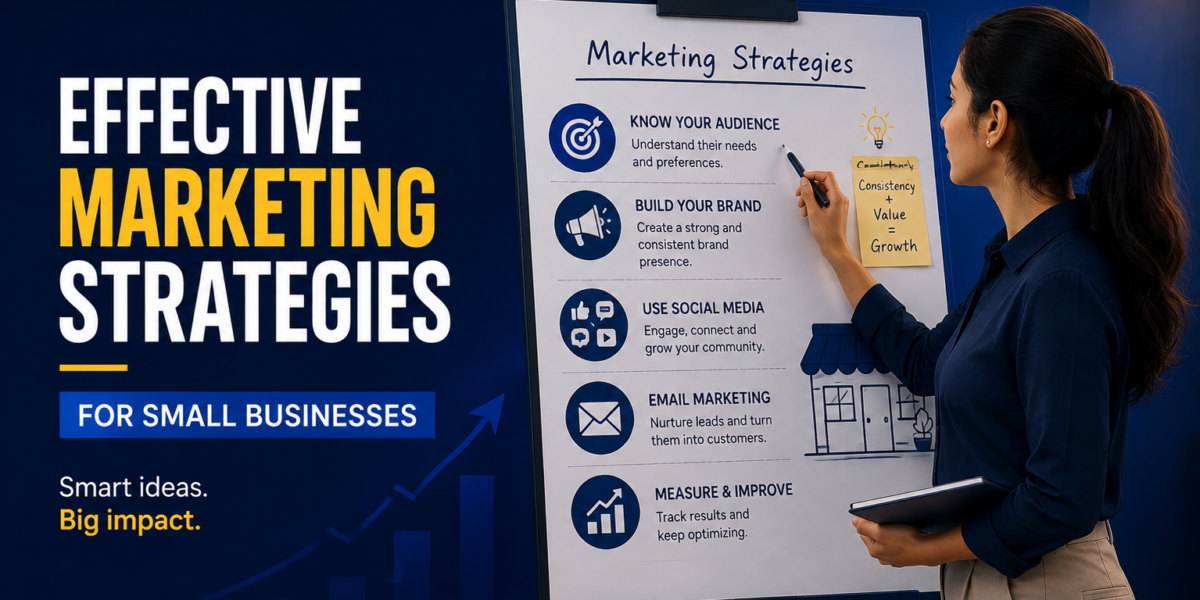
What Happens When Small Businesses Skip Real Marketing Planning
Picture a shop owner who spends money on a few random Facebook boosts, prints some flyers, and hopes customers show up. Three months later, sales have not moved and the budget is gone. This is the most common trap small businesses fall into, spending on marketing without a plan behind it. Effective marketing strategies for small businesses exist precisely to prevent this kind of wasted spending.
Most business owners searching for this are not ready to buy software or hire an agency yet, they want to understand what actually works before spending another rupee or dollar on marketing that might not pay off. This guide walks through what these strategies actually look like, how they work together, and how a small business can build a plan that survives beyond the first campaign.
What Are Effective Marketing Strategies for Small Businesses
Effective marketing strategies for small businesses are structured approaches that connect a limited budget to a clearly defined outcome, such as more calls, more foot traffic, or more online orders. In simple words, it means deciding exactly who you are trying to reach, what message will make them care, and which channel gets that message in front of them at the lowest possible cost.
Many small business owners confuse marketing activity with marketing strategy. Posting daily on social media is activity. Knowing why you are posting, who is meant to see it, and what action it should lead to is strategy. Without that second layer, most small business marketing efforts stay busy without ever becoming profitable.
Professionally speaking, this discipline sits at the intersection of limited resources, high accountability, and fast feedback loops. Small businesses cannot afford the slow trial and error that larger companies can absorb, which is exactly why choosing the right strategy matters so much more here than in a large corporate budget.
Why This Matters More Than Most Business Owners Realize
Every rupee spent without a clear strategy is a rupee that could have gone toward something measurable. Small businesses often operate on thin margins, so a few months of unfocused marketing spending can genuinely threaten cash flow, not just slow growth.
There is also a trust problem hiding behind this. Customers today research before buying almost anything, even from a local shop. A business with no consistent online presence quietly loses credibility compared to a competitor who shows up clearly across search results and social platforms. Building that visibility connects closely to what we cover in our guide on best SEO for small business.
Ignoring strategy also means missing compounding effects. A single ad brings attention once. A well planned content and search presence keeps working long after the initial effort, which is the real reason some small businesses grow steadily while others restart from zero every quarter.
How These Strategies Actually Work
At a practical level, effective marketing strategies for small businesses work by matching the right channel to the right stage of the customer journey. Someone who has never heard of your business needs a different message than someone who already visited your store or website once.
The process usually moves through four stages, awareness, consideration, conversion, and retention. Awareness introduces your business to new people. Consideration builds trust through content, reviews, and consistent presence. Conversion turns interest into an actual sale or booking. Retention keeps that customer coming back instead of buying once and disappearing.
Small businesses that only focus on awareness, such as constant ad spending with no retention plan, often end up paying repeatedly to reacquire the same customers instead of building a loyal base.
This is also where budget allocation decisions matter most. A business with a limited monthly budget gains far more by splitting spend across all four stages in smaller amounts than by pouring everything into awareness alone. Even a small portion set aside for retention, such as a simple thank you email or a repeat visit offer, tends to produce a noticeably better return than an equivalent amount spent chasing another round of cold traffic.
Core Elements of a Strong Small Business Marketing Plan
A working marketing plan is built from several connected pieces rather than a single tactic. Below is a breakdown of what each piece does and where it fits.
Local visibility ensures nearby customers can actually find your business when searching. This includes an optimized Google Business Profile and consistent local search presence, both covered in depth in our local SEO for small business guide.
Content and search visibility bring in customers who are actively searching for solutions rather than customers you have to interrupt. Our content marketing for small business guide explains how to build this without a large content team.
Social media presence builds familiarity and trust over time. This does not need to mean posting everywhere, it means being consistent on the one or two platforms your actual customers use.
Paid promotion accelerates results when timed correctly. Understanding how paid channels support organic growth is explained clearly in our performance marketing overview.
Customer retention through email, loyalty offers, or simple follow up keeps existing customers valuable instead of treating every sale as a one time event.
Step by Step Process to Build a Marketing Strategy
Building this kind of plan does not need a large team or a big budget. Following a clear sequence keeps things manageable even for a business of one or two people.
Step one is defining a single primary goal, such as more calls, more bookings, or more repeat purchases, instead of trying to improve everything at once.
Step two is identifying your actual customer, including where they search, what questions they ask, and what convinces them to choose one business over another.
Step three is choosing two or three channels to focus on fully rather than spreading thin attention across every platform.
Step four is creating simple, consistent content or offers tied directly to the primary goal from step one.
Step five is setting a realistic budget and timeline, since most marketing needs weeks or months to show measurable results, not days.
Step six is tracking results honestly, even when the early numbers are disappointing, since that data is what improves the next round of decisions.
Step seven is doubling down on whatever channel is actually producing results and slowly reducing effort on channels that are not.
Real World Examples
The following examples are illustrative scenarios meant to show how small businesses apply these strategies in practice, not case studies from a specific client.
Example one involves a local bakery. The problem was strong foot traffic on weekends but almost no visibility online. The strategy focused on claiming and optimizing their Google Business Profile, encouraging reviews, and posting simple product photos consistently, guided by practices from our local SEO consultant resource. The expected outcome is steadier weekday traffic driven by people discovering the bakery through local search rather than only walking past it.
Example two involves a small ecommerce store selling handmade accessories. The problem was decent traffic but very few repeat customers. The strategy introduced a simple email follow up sequence after purchase along with occasional loyalty offers, supported by ideas from our content marketing services guide. The expected outcome is a higher percentage of customers returning for a second purchase instead of buying once and disappearing.
Example three involves a small B2B consulting firm. The problem was relying entirely on referrals, which made growth unpredictable. The strategy shifted toward publishing educational content addressing common client questions, connected to guidance in our SEO strategy guide. The expected outcome is a steadier stream of inbound inquiries that do not depend entirely on existing client referrals.
Common Mistakes Small Businesses Make
Even motivated business owners make predictable mistakes when building a marketing plan. Recognizing these early can save months of wasted budget.
Trying every platform at once is one of the most common mistakes. Spreading a small budget and even smaller time across five platforms usually means doing all of them poorly instead of one or two well.
Ignoring existing customers is another frequent issue. Many small businesses spend heavily attracting new customers while ignoring the much cheaper opportunity of getting existing customers to return.
Copying competitors without understanding why something works for them is a mistake that quietly wastes money. What works for a competitor with a different customer base or budget may not transfer directly to your business.
Stopping too early is a final common gap. Many strategies are abandoned after a few weeks simply because results were not immediate, even though most marketing channels need consistent effort before results become visible.
Advanced Insights for Growing Small Businesses
Once the basics are working, more experienced business owners should look at how different channels reinforce each other instead of competing for the same budget. Search visibility, social proof, and paid promotion work best when they support one another rather than operating in isolation.
Working with outside support becomes worth considering once internal time becomes the real bottleneck rather than budget. Understanding the difference between hiring in house, working with a freelancer, or partnering with a small business marketing agency is covered in our freelancer versus digital marketing agency comparison.
Data discipline separates businesses that improve steadily from those that repeat the same mistakes. Reviewing what is actually converting, not just what is getting likes or views, is what turns a marketing plan into a genuine growth system rather than a guessing exercise.
Practical Checklist
Use this checklist before launching or reviewing a small business marketing plan.
A single primary goal is clearly defined and everything ties back to it. The target customer is described specifically, not generically. Only two or three channels are chosen for focused effort. Local search visibility, including a Google Business Profile, is fully optimized. Content addresses real customer questions instead of generic topics. A simple retention system exists for past customers. A realistic budget and timeline are agreed on before launch. Results are reviewed on a regular schedule, not left unchecked.
Small Business Marketing Funnel
A simple way to visualize this is as a funnel that narrows from broad reach to loyal customers.
Awareness reaches new people who have never heard of the business. Consideration builds trust through content, reviews, and consistent presence. Conversion turns interested visitors into paying customers. Retention keeps those customers coming back and referring others.
Skipping the retention stage is the most common gap, since most small business marketing effort stops the moment a sale happens.
Measuring Marketing Performance
Measuring performance goes beyond checking likes or followers. Traffic and engagement numbers matter only if they eventually connect to calls, bookings, or purchases. The more useful signals include where new customers say they heard about you, repeat purchase rate, and cost per new customer across each channel.
Reviewing this monthly, even informally, prevents budget from continuing to flow into a channel that looks active but is not actually producing results. For businesses without time to track this internally, working with an SEO agency or a broader small business marketing agency can help interpret the numbers correctly.
Future Trends Worth Watching
Search behavior is shifting toward more conversational and AI assisted queries, which means clear, direct answers to real customer questions matter more than keyword stuffed pages. Short form video continues to influence local discovery, especially for businesses that rely on visual trust such as food, retail, and services.
Personalization at a small scale, such as remembering repeat customers and tailoring simple offers to them, is becoming easier through affordable tools rather than requiring large budgets. Businesses that adapt early to these shifts, without abandoning the fundamentals covered above, tend to hold an advantage over slower competitors.
Final Recommendations
Effective marketing strategies for small businesses work best when they are treated as an ongoing system rather than a one time campaign. Start with one clear goal, choose a small number of channels, and give each enough time to actually show results before judging them.
If your team lacks the time to manage this consistently, BizBoosted offers digital marketing services built specifically around the constraints small businesses actually face, along with the full range of services available for businesses needing extra hands on support.
Conclusion
Small businesses do not fail at marketing because they lack effort, they fail because that effort is rarely connected to a clear plan, and effective marketing strategies for small businesses exist to fix exactly that gap between activity and actual results. The fix is not spending more, it is spending with intention, tracking honestly, and giving proven channels enough time to compound. If you are starting from zero, review our content marketing for small business guide and begin with a single, well executed channel before expanding further.
You may read this
Frequently Asked Questions
What are the most effective marketing strategies for small businesses
Local search visibility, consistent content, and simple customer retention systems consistently produce the strongest return for limited budgets.
How much should a small business spend on marketing
This varies widely, but many small businesses find success starting small on one or two channels and increasing budget only once results are proven.
Is social media enough for small business marketing
Rarely on its own. Social media builds familiarity, but search visibility and retention usually drive more consistent, lower cost results over time.
How long does it take to see results from small business marketing
Most consistent efforts show measurable movement within two to four months, though local search visibility can sometimes move faster.
Should a small business hire an agency or handle marketing in house
It depends on available time and expertise. Many businesses start in house and bring in outside support once internal time becomes the limiting factor.
What is the biggest mistake small businesses make with marketing
Spreading limited budget and attention across too many platforms instead of focusing fully on the one or two that actually reach their customers.
Can a small business succeed with organic marketing alone
Yes, particularly with strong local search visibility and content, though pairing this with light paid promotion often speeds up early results.



3 Comments