
What Happens When You Skip a Content Strategy
Picture a small business owner who publishes a blog post every week. Six months pass. Traffic is flat. Leads are not coming in. The content is not bad, it is just scattered, and nobody searching Google can find a clear reason to trust the brand. This is what happens without a content strategy. Effort goes in, but growth does not come out.
A content strategy is the missing plan that connects what you publish to what your business actually needs. Without it, content becomes a guessing game. With it, every blog post, video, or social update has a job to do. This guide breaks down what it really means, how it works in practice, and how to build one that actually moves the needle for your business.
What Is Content Strategy
A content strategy is a documented plan that decides what content you create, who it is for, why it exists, and how it supports business goals. In simple words, it answers three questions before a single word gets written. What problem does this content solve. Who has that problem. And what should happen after they read it.
Many beginners confuse this planning process with a content calendar. A calendar just lists dates and topics. This document explains the reasoning behind those topics, the audience they target, and the outcome expected from each piece. Without that reasoning, a calendar is just a to do list with no direction.
Professionally speaking, this discipline sits at the intersection of audience research, business goals, and search intent. It is the layer that decides whether your content marketing efforts compound over time or simply pile up without results.
Why Content Strategy Matters More Than You Think
Businesses that skip this planning usually feel the pain later, not immediately. The first few months look fine because publishing itself feels productive. The real damage shows up around month four or five, when there is a large volume of content but almost none of it ranks, converts, or gets shared.
Search engines reward topical depth and consistency. Random publishing without a strategy creates thin coverage of many topics instead of strong authority on a few. This is one reason websites with a clear content strategy tend to outrank sites that simply publish more often but with no direction. If you are exploring how ranking factors connect to planning, our SEO strategy guide breaks this down further.
There is also a cost side to this. Every article, video, or graphic takes time, writing effort, and sometimes paid promotion. When content has no strategy behind it, that investment is essentially wasted the moment it fails to reach the right audience. A weak plan does not just slow growth, it quietly drains budget that could have gone toward campaigns that actually convert.
How Content Strategy Works
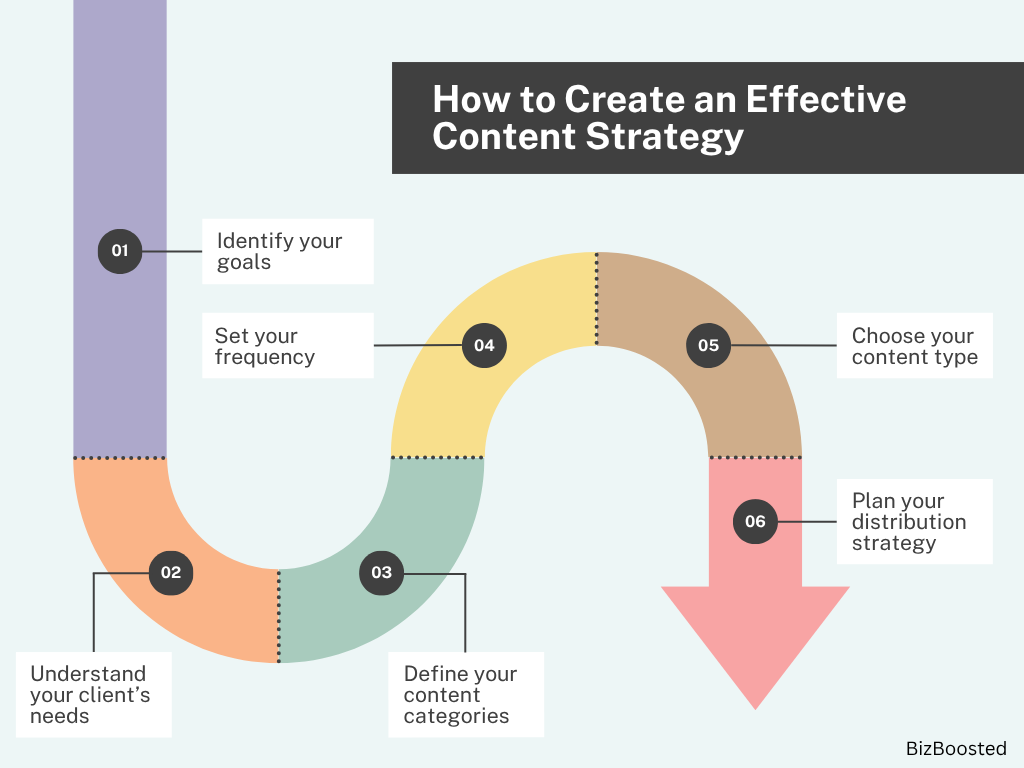
At its core, this process works by matching search intent and audience needs to a structured publishing plan. It usually starts with research, moves into planning, then production, then distribution, and finally measurement. Each stage feeds into the next.
Research uncovers what your audience is actually searching for and what gaps exist in the market. Planning turns that research into topics, formats, and priorities. Production is where the actual writing, design, or filming happens. Distribution makes sure the content reaches the right channels. Measurement closes the loop by showing what worked and what did not, which then feeds back into the next round of research.
Skipping any one of these stages weakens the whole system. Plenty of businesses jump straight to production without research, which explains why so much content exists online that answers questions nobody asked.
The Core Elements of a Strong Content Strategy
A working strategy is built from several connected pieces, not a single document. Below is a breakdown of what each element does and why it matters.
Audience research defines who you are creating content for and what their real problems look like. Skipping this step means writing content for an imaginary reader instead of a real one. Understanding your buyer, including their doubts and questions, connects directly to the work covered in our marketing fundamentals guide.
Keyword and topic research identifies the exact terms and questions people type into search engines. This step also reveals search intent, meaning whether someone wants information, wants to compare options, or is ready to buy. Our keyword research guide and search intent guide go deeper into this process.
Content pillars and clusters organize topics into groups so that related content supports each other instead of competing. This structure builds topical authority, which search engines increasingly reward over isolated articles.
Format and channel planning decides whether a topic works best as a blog post, a video, a downloadable guide, or a social post, and where that content should be published.
A distribution plan ensures content does not just sit on a website hoping to be found. This is where performance marketing and paid promotion often work alongside organic content strategy.
Governance and consistency cover who owns the calendar, how often content is published, and how quality is maintained as the team grows.
Step by Step Content Strategy Process
Building this kind of plan from scratch does not need to be complicated. Following a clear sequence keeps the process manageable, even for a small team.
Step one is defining business goals. Every plan should map back to something measurable, such as generating leads, increasing awareness, or supporting sales conversations.
Step two is researching the audience. This includes reading reviews, checking forums, and talking to actual customers about the questions they ask before buying.
Step three is conducting keyword and topic research to find what people are actually searching for around your industry.
Step four is grouping topics into pillars and clusters so content builds authority instead of scattering across unrelated ideas.
Step five is creating an editorial calendar with realistic publishing frequency based on available resources.
Step six is producing content that answers the identified search intent clearly and usefully, not just to hit a word count.
Step seven is distributing content across the right channels, including email, social platforms, and paid promotion where appropriate.
Step eight is measuring results and refining the strategy based on what the data shows.
Real World Content Strategy Examples
The following examples are illustrative scenarios used to show how this approach plays out in different business types. They are not case studies from a specific client.
Example one involves a local service business, such as a plumbing company. The problem was inconsistent bookings and almost no online visibility outside paid ads. The content strategy involved building location specific service pages, answering common repair questions, and pairing this with local SEO for small business practices. The expected outcome is more organic visibility for search terms tied to specific neighborhoods and services, reducing dependence on paid ads over time.
Example two involves an ecommerce store selling home goods. The problem was product pages with no supporting content, so shoppers were comparing products elsewhere before buying. This approach introduced buying guides, comparison articles, and FAQ style content connected to ecommerce SEO services. The expected outcome is more qualified traffic reaching product pages already informed and closer to purchase.
Example three involves a B2B SaaS company. The problem was long sales cycles with prospects who had never heard of the brand before a sales call. This approach focused on educational content addressing each stage of the buyer journey, supported by the approach in our B2B content marketing strategy guide. The expected outcome is warmer leads entering sales conversations already familiar with the product category.
Content Strategy Approach Comparison
| Business Type | Main Problem | Strategy Focus | Expected Outcome | | Local Service Business | Low visibility beyond paid ads | Location pages and local SEO | More organic local bookings | | Ecommerce Store | Weak product page context | Buying guides and comparisons | More qualified purchase ready traffic | | B2B SaaS Company | Long unaware sales cycles | Educational buyer journey content | Warmer leads for sales |
Common Content Strategy Mistakes
Even well intentioned teams make predictable mistakes when building this kind of plan. Recognizing these early can save months of wasted publishing.
Publishing without research is one of the most common mistakes. Teams choose topics based on internal opinions instead of actual search demand, which leads to content nobody searches for.
Ignoring search intent is another frequent issue. An article written for a shopper is not the same as an article written for someone just starting to learn about a topic. Mismatched intent quietly kills rankings even when the writing quality is strong.
Treating content as a one time project instead of an ongoing system is a mistake that shows up later. This process requires regular review, not a single planning session that gets ignored afterward.
Skipping distribution is another gap. Publishing great content and expecting search engines to find it instantly is unrealistic without proper promotion and internal linking.
Advanced Content Strategy Insights
Once the basics are working, more experienced marketers should look deeper into how content strategy compounds over time. Topical clusters, when structured correctly, create a snowball effect where new content strengthens existing pages instead of competing with them for the same rankings.
Internal linking plays a bigger role here than most teams realize. Strategic linking between related articles, service pages, and tools distributes authority across the site and helps search engines understand how topics connect. This is closely tied to the structure discussed in our technical SEO guide.
Advanced teams also separate content into two categories, content built to attract new visitors and content built to convert visitors already on the site. Balancing both prevents a common trap where a site gets traffic but very few conversions, or gets conversions but struggles to attract new visitors at all.
Automation is worth approaching carefully. Tools can speed up research and drafting, but this process still needs human judgment to interpret data correctly. Our overview of SEO automation explains where automation genuinely helps and where it introduces risk if used without oversight.
Content Strategy Checklist
Use this checklist before publishing new content or reviewing an existing plan.
Business goals are clearly defined and content maps back to them. Audience research is based on real customer input, not assumptions. Keyword and search intent research supports every planned topic. Topics are grouped into pillars and clusters instead of scattered randomly. A realistic publishing schedule matches available resources. Each piece of content has a clear distribution plan. Internal linking connects related articles, service pages, and tools. Performance is reviewed on a regular schedule, not left unchecked.
Content Strategy Framework
A simple way to visualize the framework is as a repeating cycle rather than a straight line.
Research leads to Planning. Planning leads to Production. Production leads to Distribution. Distribution leads to Measurement. Measurement leads back to Research.
This cycle repeats continuously. Skipping any stage, especially measurement, breaks the loop and turns the whole process back into random publishing.
How to Measure Content Strategy Performance
Measuring content strategy performance goes beyond checking pageviews. Traffic alone does not tell you whether content is doing its job. The more useful signals include organic ranking movement for target keywords, time on page, scroll depth, and whether visitors take a meaningful next step such as filling a form or requesting a quote.
Conversion tracking matters just as much as traffic tracking. A page with modest traffic but strong conversion behavior is often more valuable than a high traffic page that never leads anywhere. Reviewing this regularly connects the plan back to real business outcomes instead of vanity numbers.
For businesses without an internal analytics setup, working with a dedicated SEO agency can help interpret this data correctly and adjust the strategy based on what the numbers actually show.
Final Recommendations
Content strategy works best when it is treated as an ongoing system rather than a one time project. Start small, focus on a clear audience and a handful of pillar topics, and expand only once early content is performing. Trying to cover every possible topic from day one usually spreads resources too thin to build real authority anywhere.
Consistency matters more than volume. A business publishing two well researched articles a month, each tied to a clear stage of the buyer journey, will typically outperform a business publishing daily without any underlying plan. If your team needs support building or executing this kind of plan, BizBoosted offers content marketing services designed around exactly this kind of structured approach, and you can explore the full range of digital marketing services available for businesses that need extra hands on support.
Conclusion
A content strategy is the difference between publishing content and building a system that actually grows a business, and the businesses that skip it usually only realize the cost months later when traffic stalls and leads dry up despite the effort already spent. The fix is not more content, it is a clearer plan connecting audience research, search intent, and distribution to real business goals. If you are starting from scratch, review our content marketing for small business guide and begin with a small set of pillar topics before expanding further.
FAQs
What is content strategy in simple words
Content strategy is a plan that decides what content to create, who it is for, and why it supports business goals, instead of publishing randomly.
Is content strategy the same as content marketing
No. Content marketing is the execution, while content strategy is the planning layer that guides what gets created and why.
How long does it take to see results from a content strategy
Most businesses start seeing meaningful movement after three to six months, since search engines need time to recognize consistent topical authority.
Do small businesses really need this kind of plan
Yes, arguably more than larger businesses, since small teams cannot afford to waste limited time and budget on content with no clear direction.
What tools help with this kind of planning
Keyword research tools, analytics platforms, and planning tools such as a word counter for readability or a meta title generator for on page optimization can support the process.
Can content strategy work without a large budget
Yes. A focused strategy with a small number of well researched articles often performs better than a large budget spent on unplanned content.
How often should this plan be reviewed
Reviewing performance monthly and doing a deeper strategy review every quarter keeps the plan aligned with actual results.

3 Comments