What Is Product Page SEO?
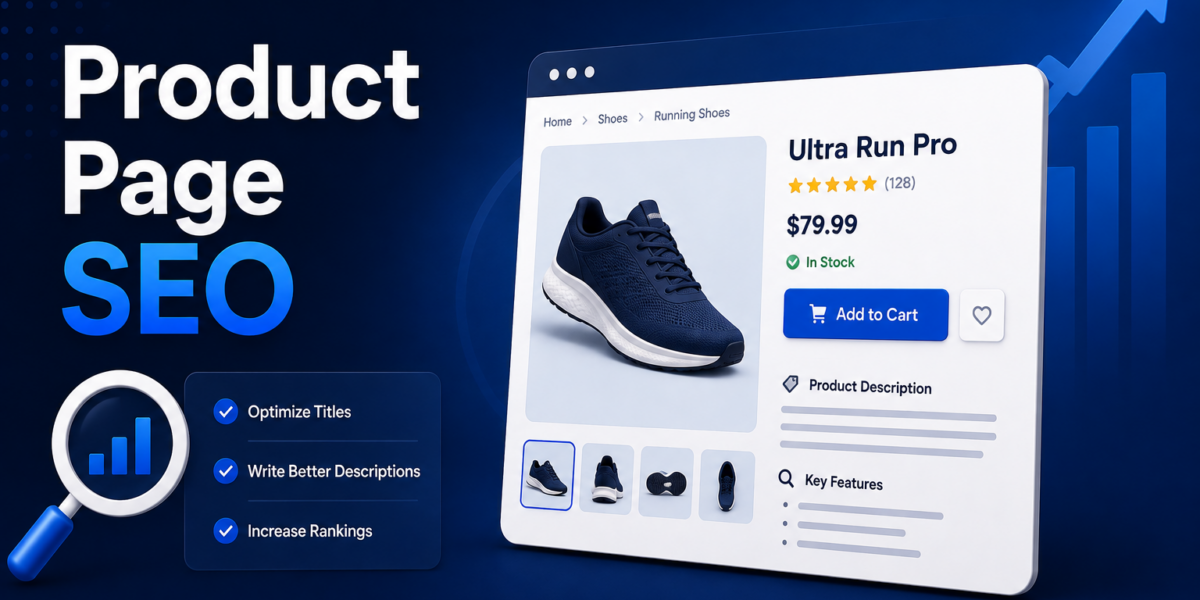
Product Page SEO is the process of optimizing individual ecommerce product pages so they can appear more prominently in search engines and attract visitors who are actively looking for the products you sell. Unlike general website SEO, product page optimization focuses specifically on pages designed to help users understand, evaluate, and purchase a particular product. This includes optimizing product titles, descriptions, URLs, images, headings, structured data, internal links, page speed, user experience, and other elements that influence both search visibility and conversions.
A product page has two jobs: help search engines understand what the product is and help shoppers decide whether to buy it. Optimizing only for search engines can create awkward descriptions that fail to persuade customers, while focusing only on design can leave search engines with insufficient information about the product. The strongest ecommerce pages balance both objectives by providing clear information, answering buyer questions, demonstrating value, and making the purchasing process simple.
If you are building your ecommerce SEO foundation, start with this SEO Strategy Guide to understand how product optimization fits into a broader organic search strategy.
Why Is Product Page SEO Important?
Product pages can target highly specific searches with strong commercial or transactional intent. Someone searching for a particular product, model, feature, size, or variation is often much closer to making a purchase than someone searching for a general informational topic.
For example, there is a major difference between someone searching for “best running shoes” and someone searching for “Nike running shoes for women size 8.” The second search communicates much stronger product-specific intent. If your product page provides exactly what that user is looking for, it can potentially attract highly qualified organic traffic.
Effective optimization can help your product pages become discoverable for relevant searches while also improving the experience for visitors who arrive through search engines. More qualified traffic, better product information, stronger trust signals, and a smoother buying experience can all contribute to ecommerce growth.
Product Page SEO vs Category Page SEO
One of the most important concepts in ecommerce SEO is understanding the difference between product pages and category pages.
A category page generally targets broader searches and groups multiple products together. A product page focuses on one specific product.
For example:
Category: Running Shoes
Subcategory: Women’s Running Shoes
Product: Women’s Lightweight Running Shoes – Model XYZ
The category page may target a broader keyword such as “women’s running shoes,” while the product page can target the specific product name, model, features, and relevant long-tail searches.
This structure helps search engines understand the hierarchy of your ecommerce website and helps shoppers move from broad product discovery toward specific purchasing decisions.
If you run an ecommerce store, your overall strategy should connect product pages, category pages, informational content, and your homepage rather than optimizing each page in isolation.
1. Conduct Keyword Research for Product Pages
Keyword research is the foundation of effective Product Page SEO. Before optimizing a product page, identify the phrases potential customers actually use when searching for that product.
Look beyond a single keyword. Your research can include:
- Product name
- Product model
- Brand name
- Product category
- Product features
- Product specifications
- Size or color variations
- Material
- Use case
- Problem solved
- Commercial modifiers
- Long-tail keywords
For example, a generic keyword such as “office chair” may be highly competitive. More specific searches such as “ergonomic office chair for back support” may better communicate the user’s needs.
Your keyword strategy should reflect the language customers naturally use. Use your Keyword Research Guide to build a more structured keyword strategy before optimizing individual product pages.
2. Optimize the Product Title
Your product title is one of the most important elements on the page because it immediately tells both shoppers and search engines what the product is.
A strong product title should clearly communicate:
Brand + Product Name + Model + Important Feature + Relevant Attribute
For example:
ABC Wireless Headphones – Noise Cancelling Bluetooth 5.3
is generally more descriptive than simply:
ABC Headphones
Avoid stuffing your product title with every possible keyword. The title should remain readable and useful for shoppers.
If customers cannot quickly understand what the product is from the title, adding more keywords will not solve the problem. Prioritize clarity and accurate product information.
3. Write Unique Product Descriptions
Duplicate product descriptions are one of the most common ecommerce SEO problems. Many online stores copy descriptions directly from manufacturers and publish exactly the same text used across dozens or hundreds of websites.
Instead, create unique descriptions that explain the product from the customer’s perspective.
A strong product description should explain:
- What the product is
- Who it is for
- Main features
- Benefits
- Materials
- Specifications
- How it works
- How to use it
- What problem it solves
- Why it is different
Do not simply list specifications. Explain why those specifications matter.
For example, instead of saying:
“Battery: 5,000 mAh.”
you could explain:
“The 5,000 mAh battery provides extended usage between charges, making the device suitable for users who need reliable performance throughout the day.”
This approach improves usefulness while naturally incorporating relevant terminology.
4. Optimize Product Page URLs
Your URL should be simple, descriptive, and easy to understand.
For example:
Good:/wireless-noise-cancelling-headphones/
Less useful:/product?id=58291&cat=12
A clean URL helps users understand the page before clicking it and makes your website structure easier to interpret.
Avoid unnecessarily long URLs, excessive parameters, and keyword stuffing. Use a concise product slug that clearly identifies the product.
If your store uses filters or product variations, make sure your technical SEO setup prevents unnecessary duplicate URLs from being indexed.
5. Use One Clear H1 Heading
Each product page should generally have one primary H1 heading that clearly identifies the product.
For example:
H1: ABC Wireless Noise-Cancelling Headphones
Supporting sections can then use H2 and H3 headings.
A logical structure might look like:
H1: ABC Wireless Headphones
H2: Key Features
H2: Product Specifications
H2: How to Use
H2: Customer Reviews
H2: Frequently Asked Questions
This creates a logical information hierarchy and makes the page easier for both users and search engines to understand.
6. Optimize Product Images
Images are extremely important for ecommerce websites because shoppers often want to see a product from multiple angles before purchasing.
However, large unoptimized images can significantly increase page load times.
For effective image optimization:
- Use descriptive filenames
- Compress images
- Use appropriate image formats
- Add meaningful alt text
- Avoid unnecessarily huge dimensions
- Provide multiple product angles
- Include detail images where useful
Instead of uploading an image named:
IMG_8472.jpg
use a descriptive filename where appropriate, such as:
black-wireless-headphones.jpg
Alt text should describe the image accurately rather than stuffing keywords.
For example:
“Black wireless noise-cancelling headphones with charging case.”
is more useful than:
“Best headphones buy headphones wireless headphones.”
7. Add Product Schema Markup
Structured data can help search engines understand important information about your products.
Product schema can communicate information such as:
- Product name
- Brand
- Image
- Description
- Price
- Availability
- SKU
- Product identifiers
- Ratings
- Reviews
When eligible, properly implemented structured data can help search engines understand your product information and may support enhanced search appearances.
However, structured data should accurately represent the visible content on your page. Do not add information simply because you want search engines to display it.
8. Optimize Product Reviews
Reviews are valuable for both shoppers and ecommerce SEO because they provide unique, user-generated content around your products.
Encourage genuine customers to leave honest reviews after purchasing. Make it easy for them to explain what they liked, how they used the product, and what they found useful.
Reviews can naturally introduce language that your business may not have considered during keyword research. Customers might describe products using specific phrases, use cases, problems, or features that other shoppers also search for.
However, never create fake reviews. Authenticity is essential for customer trust.
9. Add FAQs to Product Pages
A product page should answer the questions customers are likely to ask before purchasing.
Useful questions might include:
- What size should I choose?
- Is this product waterproof?
- How long does the battery last?
- Does it come with a warranty?
- How do I clean it?
- What materials are used?
- Is it compatible with my device?
- How long does delivery take?
- Can I return the product?
FAQs can improve the usefulness of the page while naturally covering long-tail search queries.
The best FAQs are based on real customer questions rather than artificially created keyword variations.
10. Improve Internal Linking
Internal links help users discover related products, categories, guides, and other useful content on your website.
For example, a product page for running shoes could link to:
You can also connect informational content to commercial product pages.
For example, an article about choosing running shoes could link to relevant product pages. A product page can then link back to a detailed buying guide.
This creates a strong ecommerce content cluster.
Your Internal Linking Guide explains how to build these relationships more strategically.
11. Optimize Product Page Content for Search Intent
Search intent is particularly important for ecommerce pages because users searching for products often have specific expectations.
Someone searching:
“What are running shoes?”
probably needs informational content.
Someone searching:
“Buy women’s running shoes online”
has much stronger transactional intent.
Your product page should therefore prioritize information that supports purchasing decisions.
Include clear pricing, availability, specifications, shipping information, returns, reviews, product benefits, and a visible purchase CTA.
Do not turn a product page into a 2,000-word essay simply to increase word count. Every piece of content should help the customer understand or evaluate the product.
12. Improve Page Speed
A slow ecommerce page can damage both user experience and conversions. Shoppers are less likely to wait for a product page that takes too long to load, especially on mobile devices.
Common causes of slow product pages include:
- Large images
- Excessive scripts
- Poor hosting
- Unnecessary plugins
- Third-party tracking
- Heavy page builders
- Poor caching
- Unoptimized code
Use image compression, caching, efficient code, and a reliable hosting environment to improve performance.
Technical improvements should be part of your wider Technical SEO strategy rather than treated as a separate task.
13. Make Product Pages Mobile-Friendly
A large percentage of ecommerce browsing happens on mobile devices, so your product pages must work smoothly on smaller screens.
Check:
- Product images
- Product titles
- Buttons
- Navigation
- Filters
- Product descriptions
- Reviews
- Checkout elements
Your “Add to Cart” or purchase button should be easy to find and use without requiring excessive scrolling.
Mobile users should not have to zoom in to read product information or struggle to interact with buttons.
14. Optimize the Add-to-Cart Experience
SEO can bring visitors to your product page, but conversion optimization determines what happens next.
Make the purchase process simple. Clearly communicate price, discounts, stock status, shipping information, return policies, and payment options.
Your CTA should stand out without becoming aggressive.
Examples include:
Add to Cart
Buy Now
Shop This Product
Get Yours Today
The CTA should match the type of product and buying journey.
A beautifully optimized product page that makes purchasing difficult can waste the organic traffic you worked hard to acquire.
15. Handle Out-of-Stock Products Correctly
Ecommerce stores frequently face the problem of products becoming temporarily or permanently unavailable.
Do not automatically delete every out-of-stock product page.
If the product is temporarily unavailable, keeping the page live can preserve its search visibility, reviews, backlinks, and historical value. Clearly communicate that the product is currently unavailable and, where possible, offer alternatives or an availability notification.
If the product has been permanently discontinued, determine whether a suitable replacement exists. If another product genuinely fulfills the same purpose, a carefully implemented redirect may be appropriate.
The correct solution depends on the product’s status and the value of the existing URL.
16. Avoid Duplicate Product Pages
Large ecommerce websites can accidentally create many URLs containing almost identical content.
This can happen through:
- Product variations
- Filters
- Sorting parameters
- Tracking parameters
- Duplicate categories
- Manufacturer descriptions
- Similar products
A strong ecommerce technical structure should clearly communicate which URLs should be indexed.
Use canonicalization, appropriate redirects, internal linking, and crawl controls where necessary.
Your goal is to help search engines discover the most important version of each product rather than allowing unnecessary URL variations to compete with one another.
17. Optimize Product Pages for Long-Tail Keywords
Long-tail keywords can be extremely valuable for ecommerce because they often communicate specific needs.
Examples include:
“waterproof hiking boots for women”
“wireless headphones with long battery life”
“ergonomic office chair for home working”
“organic cotton baby clothes online”
These searches may have lower volume than broad keywords, but their specificity can indicate stronger relevance.
Do not create separate pages for every tiny keyword variation unless the search intent genuinely differs. Instead, use useful product content to naturally address closely related searches.
18. Build Ecommerce Content Clusters
Product pages should not exist alone. Build supporting content around important product categories.
For example:
Pillar: Running Shoes
↓
Supporting Guide: How to Choose Running Shoes
↓
Category: Women’s Running Shoes
↓
Product: Specific Running Shoe
↓
Related Product: Running Socks
This structure allows informational content to attract people earlier in the buying journey while category and product pages capture commercial and transactional searches.
For Shopify stores, your SEO Services for Shopify resource can provide additional context around ecommerce optimization.
For WooCommerce stores, explore WooCommerce SEO Agency strategies.
19. Use High-Quality Product Copy
Product copy should sell without becoming exaggerated.
Avoid meaningless claims such as:
“The world’s greatest product!”
Instead, explain concrete benefits.
For example:
“The lightweight design makes the backpack easier to carry during long commutes, while the padded laptop compartment provides additional protection for everyday travel.”
Specific benefits are more persuasive because shoppers can understand exactly how the product fits their needs.
Good copy answers the customer’s most important question:
“Why should I buy this product instead of another one?”
20. Track Product Page SEO Performance
You cannot improve what you do not measure.
Track:
- Organic impressions
- Organic clicks
- CTR
- Keyword rankings
- Product page traffic
- Add-to-cart rate
- Conversion rate
- Revenue
- Bounce/engagement signals
- Indexed pages
- Product-rich-result performance where available
Look for products receiving impressions but few clicks. Their titles and search snippets may need improvement.
Also identify pages receiving organic traffic but generating few sales. In those cases, the problem may not be SEO. It could be pricing, trust, product quality, page experience, shipping, or the offer itself.
Product Page SEO Checklist
Before publishing a product page, check the following:
| SEO Element | Optimization Check |
|---|---|
| Product title | Clear and descriptive |
| Main keyword | Naturally included |
| H1 | Matches the product |
| Description | Unique and useful |
| URL | Short and descriptive |
| Images | Compressed and descriptive |
| Alt text | Accurate and useful |
| Schema | Properly implemented |
| Reviews | Genuine customer content |
| FAQs | Answers real questions |
| Internal links | Relevant connections |
| Mobile | Fully optimized |
| Speed | Fast loading |
| CTA | Clear and visible |
| Availability | Accurate |
| Canonical | Correct |
| Indexing | Appropriate |
| Content | Matches search intent |
Common Product Page SEO Mistakes
The most common mistake is copying the manufacturer’s description and expecting the page to rank. Hundreds of stores may use the same text, giving search engines little reason to view your page as a unique resource.
Another problem is optimizing the page for search engines while ignoring shoppers. Excessive keywords, huge blocks of text, unclear product information, weak images, and difficult checkout processes can damage the experience.
Other common mistakes include:
- Keyword stuffing
- Duplicate descriptions
- Poor image optimization
- Missing product schema
- Weak internal linking
- Slow loading speed
- Poor mobile design
- Missing reviews
- Complicated URLs
- Incorrect canonical tags
- Ignoring out-of-stock products
- Creating unnecessary duplicate URLs
Avoiding these problems creates a much stronger foundation for ecommerce growth.
Conclusion
Product Page SEO is about creating product pages that are easy for search engines to understand and genuinely useful for shoppers. Start with relevant keyword research, then optimize your product titles, descriptions, URLs, images, headings, schema, reviews, internal links, page speed, and mobile experience while keeping the customer’s buying journey at the center. Avoid duplicate content, keyword stuffing, technical issues, and unnecessary pages, and build supporting content that connects informational searches with commercial product pages. When technical SEO, helpful content, strong product presentation, internal linking, and conversion optimization work together, your product pages can attract more qualified organic traffic and turn that traffic into real ecommerce revenue.
You may Read this
FAQs
What is Product Page SEO?
Product Page SEO is the process of optimizing ecommerce product pages to improve organic visibility, attract relevant search traffic, and help visitors convert into customers.
How do I optimize a product page for SEO?
Optimize the product title, description, URL, images, headings, keywords, schema, internal links, reviews, page speed, mobile experience, and conversion elements.
Should every product page have unique content?
Yes. Unique, useful product content helps differentiate your pages from competitors and improves the overall value of the ecommerce website.
How important are product reviews for SEO?
Genuine reviews can add useful user-generated content, increase trust, and provide additional context about how customers experience a product.
Do product images affect SEO?
Yes. Properly optimized images can improve page performance, accessibility, user experience, and image-search visibility.
Should product pages have FAQs?
They can be highly useful when they answer genuine questions customers have before purchasing.
How long should a product description be?
There is no universal ideal word count. It should be long enough to explain the product, benefits, specifications, use cases, and important buying information without unnecessary filler.
Can product pages rank on Google?
Yes. Well-optimized product pages can rank for relevant product, commercial, and transactional searches when they provide useful information and meet search intent.