What Is CPC?
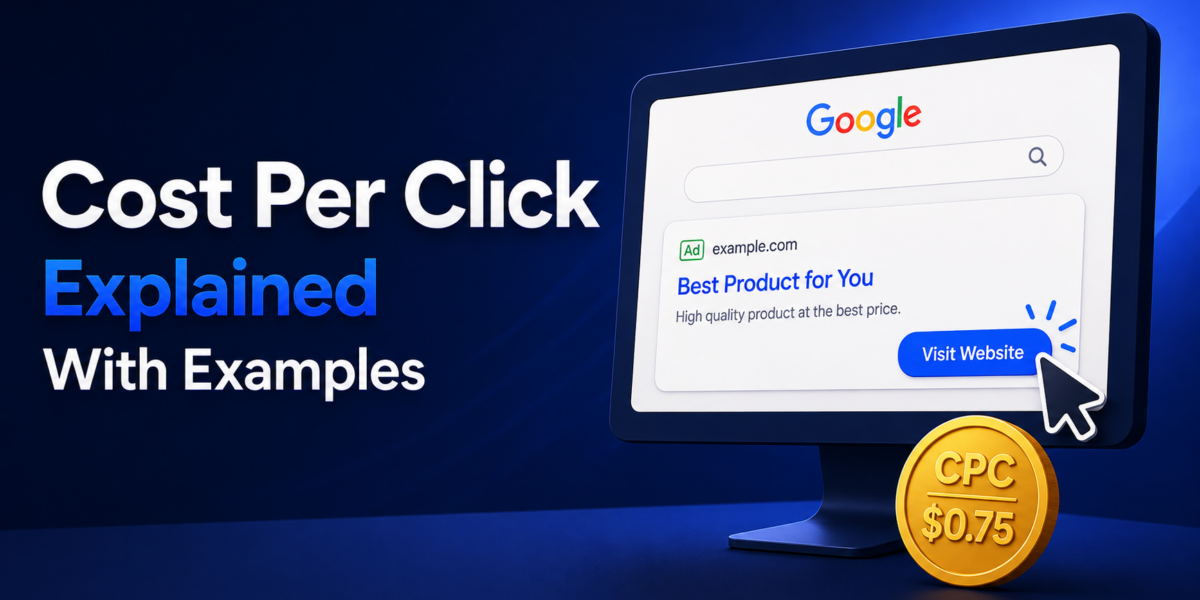
If you have ever run an online advertising campaign, you have probably seen the term CPC. But what is CPC, and why does it matter when you are spending money on Google Ads, Facebook Ads, or another advertising platform? CPC stands for Cost Per Click, which refers to how much an advertiser pays, on average, for a click on an advertisement. It is one of the most commonly used metrics in paid advertising because it helps businesses understand how much they are paying to bring visitors from an advertising platform to a website, landing page, product page, or another destination.
Understanding CPC is important because getting clicks is not enough. A campaign can have thousands of clicks and still fail to generate profitable results if those clicks are too expensive or come from people who are unlikely to become customers. On the other hand, a campaign with a higher CPC can sometimes be more profitable if those clicks generate valuable leads or sales. This means CPC should never be evaluated completely on its own. It should be considered alongside CTR, conversion rate, CPA, conversion value, ROAS, and overall profitability.
What Does CPC Mean?
CPC simply means Cost Per Click. It tells you how much you pay for each click generated by your advertising campaign. If you spend $100 and receive 200 clicks, your average CPC is $0.50. The basic calculation is straightforward: divide the total amount spent on advertising by the number of clicks received.
For example, imagine an online store spends $500 on Google Ads and receives 1,000 clicks. The average CPC would be $0.50. However, that number does not tell you whether the campaign was successful. If those 1,000 visitors generated $10,000 in profitable sales, the CPC could be very attractive. If they generated no sales, even a $0.10 CPC could be expensive because the traffic produced no meaningful business outcome.
This is why experienced advertisers do not simply try to achieve the lowest possible CPC. They try to acquire valuable clicks at an economically sustainable cost.
How Is CPC Calculated?
The simplest CPC formula is:
CPC = Total Advertising Cost ÷ Total Number of Clicks
For example, if you spend $300 and receive 600 clicks:
$300 ÷ 600 = $0.50 CPC
This means you paid an average of 50 cents for every click.
There is another important distinction between average CPC and the amount you pay for an individual click. Your average CPC represents the overall average across clicks, while individual clicks can cost different amounts depending on the advertising auction, competition, targeting, placement, device, location, and other factors.
In some advertising systems, the actual amount paid can also differ from your maximum bid. Therefore, your bid should not automatically be interpreted as the exact amount you will pay for every click.
Why Is CPC Important?
CPC is important because it helps advertisers understand the cost of generating traffic from paid advertising. When you know how much you are paying for clicks, you can compare that cost with your conversion rate and customer value to determine whether your campaigns make financial sense.
For example, suppose Campaign A has a CPC of $1 and Campaign B has a CPC of $3. At first glance, Campaign A appears better. But if Campaign A converts only 1% of visitors while Campaign B converts 8%, Campaign B may actually produce customers at a much better cost.
This is why CPC should be treated as one part of a larger performance picture. A low CPC is useful when the traffic is relevant and converts. Cheap clicks that never produce leads or sales are not necessarily a good result.
If you want to understand the broader idea of measuring advertising against business outcomes, see What Is Performance Marketing?.
What Factors Affect CPC?
Many factors can influence CPC, and the exact system varies between advertising platforms. On search advertising platforms such as Google Ads, competition and auction dynamics can have a major impact. Your ad quality, relevance, expected performance, bidding strategy, search context, targeting, and other signals can also influence how competitive your ads are.
Your industry can make a major difference as well. Keywords connected to expensive products or services can attract advertisers willing to pay more for potential customers. For example, insurance, legal services, finance, software, and certain B2B services can have significantly different CPC levels from less competitive consumer searches.
Location, device, audience, time, keyword intent, and competition can also influence costs. A highly commercial keyword searched by someone who is ready to buy can be considerably more valuable to advertisers than a broad informational keyword.
CPC and Keyword Competition
Competition is one of the biggest reasons CPC can vary. If many advertisers are competing for the same valuable search term, the advertising auction can become more competitive.
Consider a keyword such as “buy running shoes.” A user searching this phrase may have stronger purchase intent than someone searching “what are running shoes.” Because the first search can be closer to a purchase, advertisers may place greater value on that traffic.
This does not mean you should avoid competitive keywords completely. Instead, build a balanced keyword strategy that includes relevant commercial terms, long-tail searches, and opportunities where competition may be more manageable.
Your Keyword Research Guide can help you understand how keyword selection affects the broader paid and organic search strategy.
CPC and Search Intent
Search intent can have a major effect on how valuable a click is. A person searching for information may not be ready to purchase, while someone searching for a specific service or product may be much closer to taking action.
For example:
Informational: “What is SEO?”
Commercial: “Best SEO agency for small business”
Transactional: “Hire SEO agency”
All three searches relate to SEO, but the commercial value of the click can be very different.
This is why reducing CPC without considering intent can lead to poor results. You might find cheap keywords that generate plenty of traffic but very few customers. A more expensive keyword can sometimes produce significantly better conversion rates.
For a deeper explanation, read the Search Intent Guide.
What Is Average CPC?
Average CPC is the average amount you paid for each click across your campaign, ad group, keyword, or selected reporting period.
For example, if your campaign spends $1,000 and receives 2,000 clicks, your average CPC is $0.50.
However, average CPC can hide important differences. One keyword may cost $0.20 per click while another costs $2.50. One audience may generate inexpensive traffic while another costs more but produces significantly better conversions.
Therefore, when analyzing CPC, break your data down into useful segments. Look at campaigns, ad groups, keywords, locations, devices, audiences, and other available dimensions to identify where costs are coming from.
CPC vs CPM
CPC and CPM measure different things.
CPC = Cost Per Click
CPM = Cost Per 1,000 Impressions
CPC focuses on clicks, while CPM focuses on how much you pay to show your advertisement 1,000 times.
CPC can be especially useful when your objective is to generate website traffic or measurable clicks. CPM can be more relevant when your primary objective is reach or awareness.
Neither metric is automatically better. The right measurement depends on your campaign objective.
CPC vs CPA
CPC measures the cost of a click, while CPA measures the cost of acquiring a conversion.
For example, you could have:
CPC = $1
Conversion Rate = 5%
If you receive 100 clicks, you spend $100 and generate approximately five conversions. Your approximate cost per conversion would therefore be $20.
This demonstrates why CPC alone is not enough. If you can reduce CPC from $1 to $0.80 but your conversion rate falls dramatically, your campaign could actually become less profitable.
The ultimate goal is not simply cheaper traffic. It is better business results from your advertising investment.
CPC vs CTR
CTR, or Click-Through Rate, measures how frequently people click an advertisement after seeing it.
A simplified formula is:
CTR = Clicks ÷ Impressions × 100
CPC tells you what you paid for those clicks, while CTR tells you how effectively your advertisement attracted clicks from the people who saw it.
These metrics are connected but answer different questions.
CTR asks: Are people clicking?
CPC asks: How much are those clicks costing?
A strong campaign should ideally attract relevant clicks at a sustainable cost.
How to Lower CPC
If your CPC is too high, do not immediately reduce bids or pause expensive keywords. First identify why the CPC is high. You may be targeting extremely competitive terms, using broad keywords, reaching an expensive audience, or running advertisements that are not sufficiently relevant.
Improving relevance can be an important part of the solution. Make sure your keyword themes, advertisements, and landing pages are closely connected. When users see an advertisement that directly addresses their search and then land on a page that delivers what was promised, the overall experience can improve.
You should also review your keyword strategy. Highly broad keywords can attract irrelevant clicks, while more specific long-tail searches can sometimes provide better control over intent and targeting.
Improve Your Ad Relevance
Your advertisement should clearly match what the user searched for. If someone searches for “Google Ads management,” an advertisement specifically discussing Google Ads management is generally more relevant than a generic “Digital Marketing Services” advertisement.
Create focused ad groups and write messaging that reflects the underlying search intent. Your headline, description, offer, and landing page should work together rather than communicating completely different messages.
This can also help improve the overall quality of your campaigns. If you want to understand how ad relevance connects with Google’s diagnostic metrics, read Google Ads Quality Score.
Improve Your Landing Page
Your landing page can influence the overall performance of your advertising campaign. If your advertisement promises one thing but your landing page provides something completely different, visitors may leave without converting.
A strong landing page should be relevant to the advertisement, easy to understand, mobile-friendly, fast enough for users, and focused on the desired action.
For example, if your advertisement promotes “Google Ads Management for Small Businesses,” sending users to a highly relevant service page is generally more logical than sending them to a generic homepage where they must search for the service themselves.
A better post-click experience can help improve conversion performance, which is ultimately more important than reducing CPC by a few cents.
Improve Your Quality and Relevance
For Google Ads, improving the relevance and quality of your campaign can be an important part of optimization. Google evaluates factors related to expected CTR, ad relevance, and landing page experience through its Quality Score diagnostic.
However, do not treat a Quality Score of 10/10 as the only goal. The purpose of optimization is to improve actual campaign performance.
If your campaign produces profitable customers at an acceptable acquisition cost, a keyword with a lower diagnostic score is not automatically a failure. Focus on the complete customer journey rather than one dashboard metric.
Use Negative Keywords
Negative keywords can help prevent your advertisements from showing for searches that are irrelevant to your business. This can reduce wasted clicks and improve traffic quality.
Suppose you sell premium marketing services but your advertisements are appearing for searches such as “free marketing course” or “marketing jobs.” Those searches may produce clicks without producing customers.
Adding appropriate negative keywords can help filter out irrelevant traffic. This is especially important when using broader keyword targeting.
The goal is not simply to get fewer clicks. The goal is to eliminate clicks that have little or no chance of creating business value.
Improve Your Keyword Strategy
A strong keyword strategy combines relevance, intent, competition, and commercial value. Do not choose keywords only because they have a large search volume or low CPC.
A keyword with 10,000 monthly searches may generate enormous traffic but little revenue if the search intent does not match your offer. A keyword with 500 searches could potentially generate more customers if those searches come from people actively looking for your product or service.
This is why keyword research should be connected to business objectives. Identify which searches represent awareness, consideration, and purchase intent, then create campaigns that match those stages.
Use Geographic Targeting Carefully
If your business serves specific locations, geographic targeting can help you avoid paying for clicks from people you cannot serve.
For example, a local dental clinic in one city may not benefit from paying for clicks from users hundreds of miles away. Tightening location targeting can reduce irrelevant traffic and help the advertising budget focus on potential customers.
However, do not make geographic targeting unnecessarily narrow if your business serves a wider market. Review your actual customer data before making significant targeting changes.
For businesses focused on local visibility, Local SEO for Small Businesses can complement paid advertising by helping you build organic visibility in relevant geographic searches.
Improve CPC Without Destroying Conversions
This is one of the most important principles in paid advertising: do not lower CPC at any cost.
Imagine you reduce your CPC from $2 to $1 by targeting a much broader audience. Your traffic becomes cheaper, but your conversion rate falls from 8% to 1%. You may have saved money on individual clicks while making the overall campaign much less effective.
Instead, optimize toward profitable outcomes. Compare CPC with conversion rate, CPA, conversion value, and customer lifetime value where appropriate.
The best CPC is not necessarily the lowest CPC. It is the CPC that allows you to acquire relevant traffic and generate profitable business results.
How to Improve CPC on Facebook Ads
The principles are similar on social advertising platforms, although the auction and delivery systems differ. Your audience, creative quality, engagement, campaign objective, placement, competition, and relevance can influence advertising costs.
If your Facebook CPC is increasing, test different creative concepts rather than simply increasing your budget. Improve your hooks, visuals, messaging, and audience alignment.
Your Social Media Marketing Campaigns guide can help you build campaigns around clear objectives instead of treating every social advertisement as a simple traffic campaign.
How to Track CPC Effectively
Do not look at CPC only once a month. Monitor it alongside other important metrics and look for trends.
A useful reporting dashboard can include:
- Impressions
- Clicks
- CTR
- Average CPC
- Conversions
- Conversion rate
- Cost per conversion
- Conversion value
- ROAS
- Revenue
For example, if CPC rises by 15% but conversion value rises by 40%, the campaign may actually be improving.
Likewise, if CPC falls by 30% but conversions collapse, the lower CPC is not necessarily a positive development.
This is why professional campaign analysis looks at relationships between metrics, not isolated numbers.
Common CPC Mistakes
One of the biggest mistakes advertisers make is assuming that the cheapest click is automatically the best click. This can lead to broad targeting, low-quality traffic, and poor conversion rates.
Another mistake is changing too many campaign settings simultaneously. If you change bids, keywords, targeting, advertisements, landing pages, and budget all at once, it becomes difficult to understand which change affected CPC and conversions.
Advertisers also sometimes compare CPC across completely different industries or platforms without considering the differences in audience value and competition. A $3 CPC may be expensive for one campaign and completely reasonable for another.
| Mistake | Better Approach |
|---|---|
| Chasing the lowest CPC | Optimize for profitable conversions |
| Ignoring search intent | Target relevant searches |
| Using overly broad keywords | Build focused keyword groups |
| Ignoring negative keywords | Filter irrelevant searches |
| Looking only at CPC | Compare CPC with conversions |
| Changing everything at once | Test strategically |
| Ignoring landing pages | Improve post-click experience |
What Is a Good CPC?
There is no universal “good” CPC. A good CPC depends on your industry, audience, conversion rate, average order value, customer lifetime value, competition, profit margin, and campaign objective.
Suppose Business A makes $1,000 in profit from every customer and converts 5% of qualified clicks. It may be able to afford a much higher CPC than Business B, which earns only $50 from each customer.
Therefore, instead of asking only “What is a good CPC?”, ask:
“What CPC can my business sustainably afford while remaining profitable?”
This question produces a much more useful advertising strategy.
CPC Optimization Checklist
Before changing your campaign, review these areas:
- Are your keywords highly relevant?
- Does search intent match your offer?
- Are your advertisements specific?
- Are your landing pages relevant?
- Are irrelevant searches being filtered?
- Are you targeting the right locations?
- Are your audiences appropriate?
- Is your CTR healthy?
- Are your clicks converting?
- Is your CPA sustainable?
- Are conversions generating enough value?
- Are you comparing CPC with actual business results?
If several of these areas are weak, lowering bids alone will not solve the underlying problem.
Conclusion
What is CPC is a simple question, but understanding CPC properly requires looking beyond the price of an individual click. Cost Per Click tells you what you are paying for traffic, while conversion rate, CPA, conversion value, and ROAS help you determine whether that traffic is actually valuable. To improve CPC performance, focus on relevant keywords, strong advertisements, useful landing pages, negative keywords, accurate targeting, and continuous testing rather than simply chasing the lowest possible cost. The best advertising strategy is not the one that buys the cheapest clicks—it is the one that turns relevant clicks into profitable customers consistently.
You may read this
FAQs
What is CPC?
CPC stands for Cost Per Click and measures how much an advertiser pays, on average, for each click on an advertisement.
How is CPC calculated?
CPC is calculated by dividing total advertising spend by the total number of clicks.
What is a good CPC?
There is no universal good CPC. It depends on your industry, competition, conversion rate, customer value, and advertising goals.
How can I lower CPC?
You can potentially improve CPC by increasing relevance, improving advertisements and landing pages, refining keywords, using negative keywords, and targeting the right audience.
Is a low CPC always better?
No. A low CPC is not useful if the clicks do not generate valuable leads, sales, or other business outcomes.
What is the difference between CPC and CPA?
CPC measures the cost of a click, while CPA measures the cost of acquiring a conversion.
What is the difference between CPC and CPM?
CPC measures the cost of clicks, while CPM measures the cost of 1,000 ad impressions.
Does Quality Score affect CPC?
Quality and relevance can influence Google Ads auction performance, but CPC is affected by multiple factors and cannot be predicted from Quality Score alone.