
Introduction
Ask ten small business owners if they have an SEO strategy, and eight will say yes. Ask them to explain it in two sentences, and most will start listing individual tasks instead: “we write blog posts,” “we added keywords to our website,” “we’re on Google Business Profile.” Those are SEO activities. They are not a strategy.
An SEO strategy is a documented plan that connects your business goals to specific search visibility outcomes, backed by a clear understanding of who you’re trying to reach and what they’re searching for before they become a customer. It tells you which keywords matter, which pages need to exist, what content gets published and when, and how technical health, on page optimization, and link building work together instead of happening in isolation.
The difference matters more than it sounds. A business without an SEO strategy might publish 40 blog posts over a year and see almost no change in traffic, because the posts weren’t chosen based on real search demand or connected to each other in a way that builds topical authority. A business with a strategy might publish half as much content and outperform them, because every piece serves a specific purpose in a bigger plan something we cover in more depth in our content marketing guide for small businesses.
Why an SEO Strategy Matters More Than Any Single Tactic
Individual SEO tactics — writing a meta description, building a backlink, fixing a broken link are easy to learn and easy to execute. That’s exactly why they don’t create a competitive advantage on their own. If a tactic is easy enough that anyone can copy it from a blog post, it won’t be what separates your site from everyone else’s.
Strategy is the layer where you decide which tactics matter for your specific business, in what order, and why. Two businesses in the same industry can use identical tactics and get completely different results because one has a strategy connecting those tactics to a bigger picture and the other is just checking boxes.
There’s also a compounding effect that only shows up with a real strategy. A single optimized page might bring in modest traffic. Ten pages that are part of a planned content cluster, all linking to each other, tend to outperform ten random pages combined — because search engines increasingly reward sites that demonstrate real depth on a subject.
The Core Elements of a Working SEO Strategy
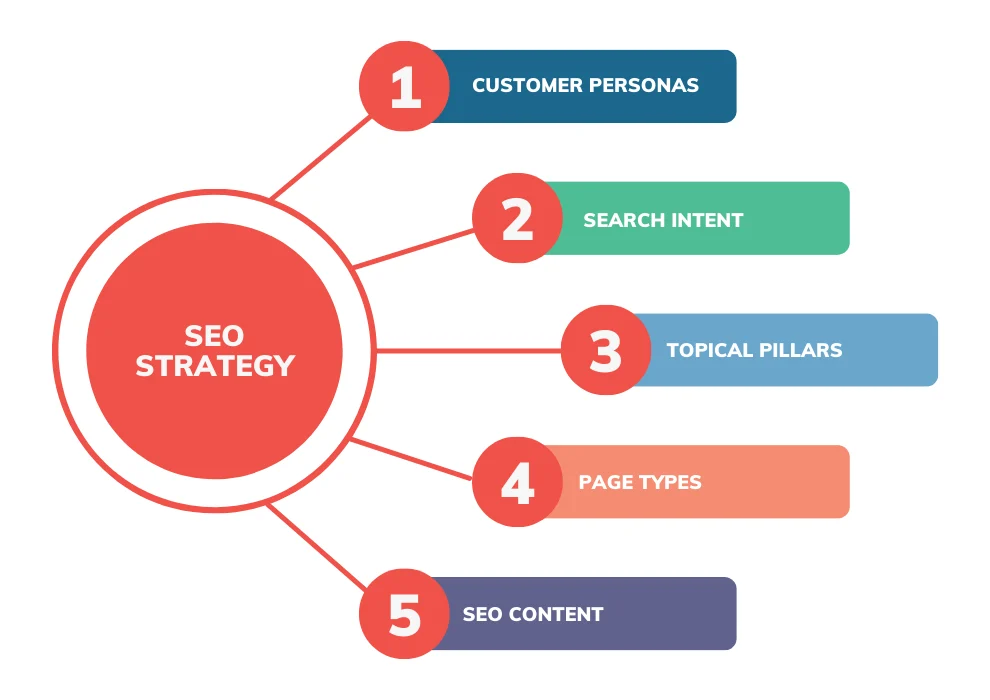
A complete SEO strategy has four parts working together. Skipping any one is usually why businesses feel like they’re “doing SEO” without seeing results.
Keyword and search intent research. Before writing a single page, you need to know what your potential customers are typing into Google, and what they want when they type it. Someone searching “what is local SEO” wants an explanation. Someone searching “local SEO services near me” wants to hire someone.
On page and technical foundation. This covers everything that makes a page easy for search engines and humans to understand titles, headings, internal linking, site speed, and mobile experience. A brilliant piece of content on a technically broken website often won’t rank.
Content strategy and topical authority. Instead of publishing whatever comes to mind, content is planned around clusters a main pillar topic supported by related articles that all link to each other, similar to how our SEO automation guide connects to related tools and process articles.
Authority and trust signals. This includes backlinks, reviews, and consistent business information across the web especially important if you’re relying on local SEO for small business growth. This is usually the slowest part to build and the one most businesses neglect.
Step by Step: Building an SEO Strategy From Scratch
Step 1: Define the actual business goal, not just “more traffic.” More traffic that doesn’t convert isn’t a win. Decide upfront whether the goal is more phone calls, more online sales, more newsletter sign ups, or more brand visibility, because that single decision shapes almost every choice that follows in your SEO strategy.
Step 2: Research keywords based on real search volume and realistic competition favor long tail and local intent terms early on rather than jumping straight into the broadest, most crowded searches where established competitors already dominate page one.
Step 3: Map keywords to search intent and page type. Informational keywords map to blog content; commercial keywords map to service pages. Mixing these up is one of the most common reasons a page ranks but still doesn’t generate any real business.
Step 4: Audit and fix the technical foundation page speed, mobile experience, and crawl errors. It’s tempting to skip straight to content, but a technically broken site quietly caps how well any of that content can ever perform.
Step 5: Build content in clusters, not isolated posts. Choose a pillar topic, then plan several supporting articles that link back to it and to each other, so the whole group works together instead of competing for attention separately.
Step 6: Optimize on page elements for every piece of content titles, meta descriptions, headings, and internal links, all written for a real reader first and search engines second.
Step 7: Build authority consistently. A steady pace of backlinks, guest content, and consistent business listings outperforms occasional intense bursts of effort followed by long stretches of inactivity.
Step 8: Track, measure, and adjust quarterly. Rankings and conversions should be reviewed regularly, and underperforming pages updated and improved rather than abandoned and forgotten.
Real World Examples: How This Looks in Practice
Example 1: A local service business (HVAC company). A mid sized HVAC company was ranking for their business name but nothing else. Their strategy started with service plus location pages (“AC repair in [city]”) instead of one generic services page, paired with consistent Google Business Profile optimization. Within a few months, they began appearing for location specific searches they’d never ranked for before.
Example 2: An ecommerce store selling home goods. This store had strong product pages but almost no informational content, so they only captured shoppers who already knew exactly what they wanted. Their strategy added “how to choose” and buying guide content for main product categories, each linking to relevant product pages capturing earlier stage shoppers and guiding them naturally toward a purchase.
Example 3: A B2B SaaS company. A project management SaaS company was competing against much larger competitors on broad terms like “project management software” and getting nowhere, since those searches were already dominated by companies with years of accumulated authority. Their strategy shifted toward long tail, use case specific keywords like “project management software for construction teams” and “project management tool for remote agencies,” similar to the approach outlined in our B2B content marketing strategy guide. Content built around these narrower, more specific use cases started ranking within a reasonable timeframe and brought in far more qualified leads than the broad, generic terms ever had proof that a smaller, sharper target often beats a bigger, blurrier one.
Example 4: A local consultant just starting out. A freelance business consultant with no existing website traffic and no backlinks began by targeting very specific, low competition questions her ideal clients were actually asking, rather than trying to rank for “business consultant” on day one. Each article answered one real question thoroughly, linked to two or three related articles, and ended with a simple next step. Within several months, this small, connected cluster of content was outperforming pages on competitor sites that had been online for years but never had a coordinated strategy behind them.
Most businesses only build content for Stage 1, or jump straight to Stage 3 without connecting the two. A strong SEO strategy builds content for every stage and links them together, so a reader who starts at a blog post has a natural path toward your services page when they’re ready.
Beginner vs. Advanced SEO Strategy Approach
| Element | Beginner Approach | Advanced Approach |
|---|---|---|
| Keyword targeting | Broad, high competition terms | Long tail, intent specific terms |
| Content planning | Random topics, published whenever | Planned clusters with internal links |
| Technical SEO | Ignored until something breaks | Audited quarterly as routine |
| Link building | Occasional, reactive | Consistent, planned outreach |
| Local SEO | Listing created once | Profile actively updated, reviews requested |
Aligning Your SEO Strategy With Your Business Type
Not every business needs the same SEO strategy, even within the same broad industry. A local service business, an ecommerce store, and a B2B SaaS company all search, buy, and convert differently, and copying someone else’s exact plan rarely works as well as building one around how your own customers actually behave.
Local businesses generally get the fastest results from a strategy centered on location specific pages, Google Business Profile optimization, and reviews, because so much local search intent is tied to “near me” and city specific phrasing. Ecommerce businesses usually benefit most from a strategy that pairs strong product pages with earlier stage informational content, since a large share of shoppers are still comparing options before they’re ready to buy. B2B and SaaS companies tend to see the strongest return from a narrower, use case driven SEO strategy, because their buyers are fewer in number but far more specific about what they’re searching for.
The common thread across all three is that the underlying framework research, planning, content clusters, technical health, and consistent authority building stays the same. What changes is where the emphasis sits and how quickly each part of the strategy is expected to pay off.
Common Mistakes That Quietly Sabotage SEO Strategies
Chasing keywords with no real search intent match. This brings visitors who leave immediately, which can hurt rankings over time.
Publishing content with no internal linking plan. A blog post sitting alone, with nothing linking to it, struggles to build authority no matter how well it’s written.
Treating SEO as a one time project. A strategy built once and never revisited slowly loses ground even if nothing about the website changed.
Ignoring technical health. Slow load times and poor mobile experience quietly undermine even the best content.
Expecting fast results. SEO strategy is a compounding effort meaningful results typically take months, not weeks.
Advanced Strategy Considerations
Once the fundamentals are in place, prioritize updating existing high potential pages over constantly publishing new ones — a page already getting some traffic and sitting just outside the top results often has more upside than a brand new post starting from zero. Pay attention to search intent shifts over time, since a keyword that was purely informational a year ago may now show commercial results in the search listings, which signals that your content approach for that keyword needs to evolve too.
Treat internal linking as an ongoing task rather than a one time setup: as new content gets published, older articles should be revisited and linked to it where relevant, so authority keeps flowing through the whole site rather than pooling only in the newest pages, much like the internal structure we maintain across our own SEO services guide and related posts. Experienced marketers also tend to watch for keyword cannibalization multiple pages quietly competing for the same search term which can weaken every one of those pages instead of strengthening any single one of them.
Practical SEO Strategy Checklist
- Business goals are clearly defined beyond “more traffic”
- Keyword research is based on real search volume and intent
- Content is planned in clusters, not isolated posts
- Every page has one clear primary keyword focus
- Internal linking connects related content deliberately
- Technical health is checked regularly
- Backlink building happens consistently, not in bursts
- Local listings and reviews are actively maintained
- Performance is reviewed and adjusted quarterly
Measuring Whether Your SEO Strategy Is Working
Rankings alone don’t tell the full story. A page can rank on page one and still fail to bring in business if it attracts the wrong audience or doesn’t guide visitors toward a next step. A useful SEO strategy is measured across organic traffic trends, click through rate, time on page, and ultimately how many visitors turn into leads a more honest picture than obsessing over a single ranking position.
Final Recommendations
Start narrow and specific rather than broad and generic a smaller site with a focused, well executed strategy around a few clusters will usually outperform a larger site with scattered content. Build the technical foundation before scaling content production, and treat the strategy as a living plan that gets reviewed and adjusted, not written once and forgotten.
Conclusion
A real SEO strategy is not a list of tasks it’s a connected plan that ties keyword research, content, technical health, and authority building to an actual business goal, reviewed over time rather than left untouched after launch. If you’re ready to move from scattered SEO efforts to a structured plan built around your specific business, that’s exactly the kind of groundwork worth getting right from the start get in touch if you’d like a second pair of eyes on where to begin.
You may also read this
FAQs
How long does an SEO strategy take to show results?
Most businesses see meaningful movement within three to six months, depending on competition and consistency.
Do local and national businesses need different SEO strategies?
Yes local businesses should prioritize location keywords and Google Business Profile, while national businesses focus more on broader content clusters.
How many keywords should an SEO strategy target?
Focus on covering a topic through clusters rather than a fixed number 8 10 connected articles usually beat 30 unrelated ones.
Is content or backlinks more important?
Both matter together. Content without authority struggles to rank, and authority without good content has nothing worth linking to.
Can a small business compete with larger competitors?
Yes, especially by targeting long tail, local intent keywords that larger competitors often ignore.
How often should an SEO strategy be reviewed?
Quarterly works well for most businesses frequent enough to catch problems without constantly changing direction.

3 Comments