By BizBoosted Team · Updated June 2026 · 12 min read
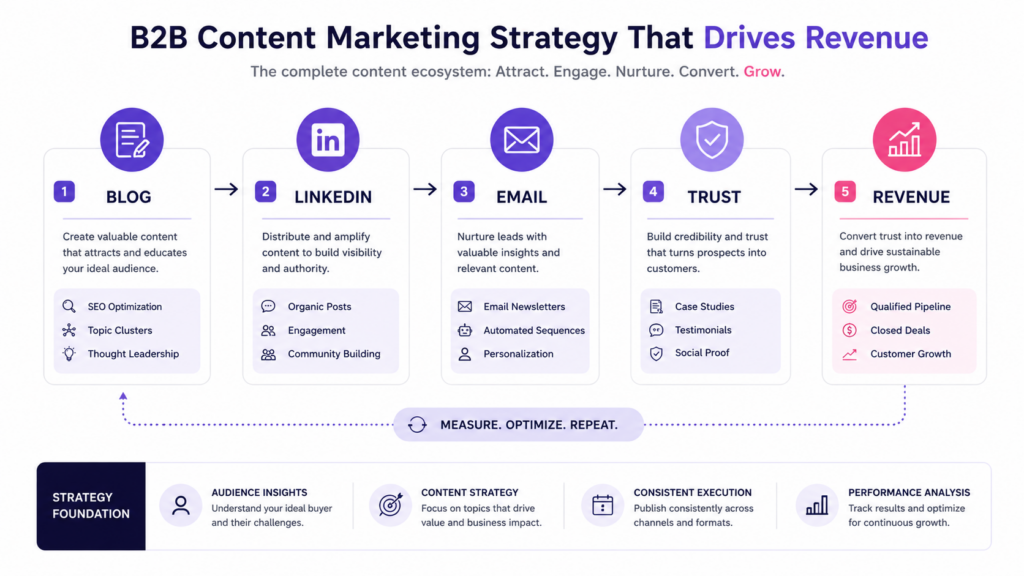
Table of Contents
- Introduction
- What Is a B2B Content Marketing Strategy?
- Why B2B Content Marketing Matters More in 2026
- Understanding the Modern B2B Buyer Journey
- Building Audience Research and Buyer Personas
- Creating Content Pillars for Topical Authority
- Developing a Multi-Channel Content Distribution Strategy
- SEO and AI Search Optimization for B2B Brands
- Lead Generation and Conversion Optimization
- Measuring Content Marketing Performance
- Common B2B Content Marketing Mistakes to Avoid
- Future Trends Shaping B2B Content Marketing
- Conclusion
- FAQs
The digital marketing landscape has evolved dramatically over the last few years, and businesses that rely on outdated content tactics are finding it increasingly difficult to compete. Search engines are becoming smarter, artificial intelligence is reshaping information discovery, and buyers are conducting more independent research before ever speaking with a sales representative. As a result, businesses must develop a structured and scalable B2B Content Marketing Strategy that aligns with modern buyer expectations and emerging search technologies.
For B2B organizations, content is no longer just a traffic-generation tool. It has become a critical asset that influences brand perception, builds authority, nurtures leads, and supports revenue growth. Whether a company offers software solutions, professional services, manufacturing products, or enterprise consulting, strategic content can educate prospects and move them through the buying journey more effectively than traditional marketing methods.
At BizBoosted, we have observed that organizations achieving sustainable organic growth are those that prioritize educational, value-driven, and experience-backed content. These companies understand that trust is earned through consistent expertise rather than promotional messaging. In 2026, successful content marketing requires a balance between SEO, user experience, audience insights, and AI search visibility.
This guide explores every major component of a successful B2B Content Marketing Strategy, providing actionable insights that businesses can implement to improve visibility, attract qualified leads, and establish long-term authority within their industry.
What Is a B2B Content Marketing Strategy?
A B2B Content Marketing Strategy is a structured framework that guides how a business plans, creates, distributes, and measures content to attract and convert other businesses. Unlike B2C marketing, which often focuses on emotional purchasing decisions, B2B marketing addresses longer sales cycles, multiple decision-makers, and more complex purchasing processes. The strategy ensures every content asset supports a specific business objective.
A strong strategy goes far beyond publishing blog posts. It includes audience research, content planning, SEO implementation, lead nurturing, distribution channels, analytics, and performance optimization. Every piece of content should serve a purpose, whether that purpose is increasing brand awareness, educating prospects, generating leads, or supporting sales conversations.
Another important aspect of strategy is consistency. Many organizations produce content sporadically without a clear direction, resulting in low engagement and limited results. A strategic approach creates alignment between marketing goals, audience needs, and business growth objectives, ensuring content efforts contribute measurable value over time.
Why B2B Content Marketing Matters More in 2026
The importance of content marketing continues to increase as digital competition grows across nearly every industry. Buyers now rely heavily on online research before contacting sales teams, making content one of the first touchpoints between a brand and its potential customers. Businesses that fail to provide valuable information risk losing opportunities to competitors who educate prospects more effectively.
Search behavior is also changing rapidly. Traditional search engines remain important, but AI-powered platforms such as ChatGPT, Gemini, and Perplexity are becoming influential sources of information. These systems prioritize authoritative, trustworthy, and experience-driven content. Companies that demonstrate expertise through comprehensive content are more likely to be referenced and discovered across multiple search environments.
Businesses that consistently publish educational content also strengthen their brand credibility. Decision-makers are more likely to trust organizations that openly share insights, industry expertise, and practical solutions. In many cases, trust established through content becomes a significant competitive advantage that influences purchasing decisions.
Understanding the Modern B2B Buyer Journey
The B2B buyer journey has become increasingly complex due to the availability of information online. Buyers are no longer dependent on sales representatives to learn about products or services. Instead, they conduct extensive research independently, consuming multiple forms of content before initiating contact with a company.
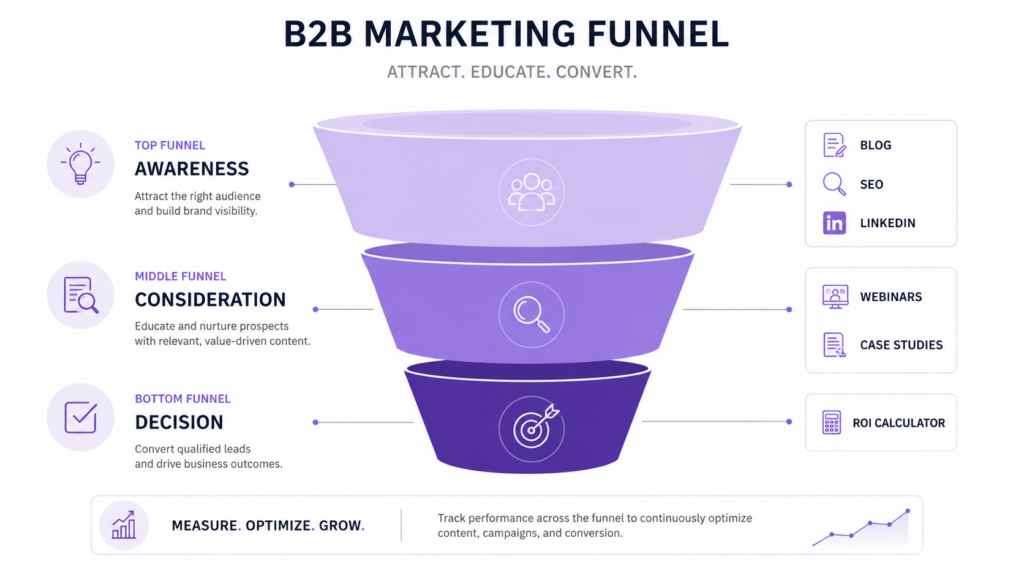
The awareness stage represents the beginning of this journey. At this point, potential customers recognize a problem or opportunity but may not yet understand the available solutions. Educational blog posts, industry reports, thought leadership articles, and informative videos are particularly effective during this phase because they help buyers define their challenges and explore potential approaches.
The decision stage focuses on selecting a provider. Buyers seek proof that a solution can deliver results. Success stories, testimonials, implementation guides, ROI analyses, and consultation opportunities help build confidence and reduce perceived risk. A successful B2B Content Marketing Strategy supports all stages of the buyer journey rather than focusing exclusively on top-of-funnel traffic generation.
Building Audience Research and Buyer Personas
One of the most common reasons content marketing fails is inadequate audience understanding. Businesses often create content based on assumptions rather than real customer insights. Effective audience research helps organizations identify the challenges, goals, questions, and decision-making factors that influence purchasing behavior.
Buyer personas provide a practical framework for organizing audience insights. A persona represents a detailed profile of an ideal customer, including job responsibilities, industry challenges, objectives, preferred content formats, and purchasing concerns. These profiles enable marketers to create content that resonates more effectively with target audiences.
For example, a marketing manager evaluating SEO services may prioritize lead generation and reporting transparency, while a business owner may focus on revenue growth and return on investment. Understanding these differences allows marketers to tailor messaging and content assets to specific audience segments.
At BizBoosted, we recommend revisiting audience research regularly because market conditions, technology, and customer expectations evolve continuously. Organizations that maintain an up-to-date understanding of their audience are better positioned to create content that remains relevant, valuable, and competitive in an increasingly crowded digital landscape
Creating Content Pillars for Topical Authority
One of the most effective ways to build long-term organic visibility in 2026 is through content pillars. Rather than publishing disconnected articles across random topics, successful B2B brands organize content around strategic themes that demonstrate deep expertise. This approach strengthens topical authority, improves internal linking, and helps both search engines and AI-powered discovery platforms understand the brand’s area of specialization.
A content pillar is a comprehensive resource that covers a broad topic in depth while connecting to supporting content pieces that expand on individual subtopics. For example, a digital marketing agency may build a pillar around SEO services and support it with related articles covering technical SEO, AI SEO, content optimization, local SEO, link building, reporting, and conversion strategies. Together, these assets create a knowledge ecosystem instead of isolated content pages.
Topical authority has become increasingly important because search systems now evaluate expertise at a domain level rather than focusing only on individual pages. Businesses that consistently demonstrate subject depth often achieve stronger visibility across traditional search engines and AI-generated answers. This aligns closely with EEAT principles by showcasing experience, expertise, authority, and trust through connected content experiences.
A practical way to develop content pillars is to identify three to five core business categories and expand each category into supporting educational assets. Every article should answer a specific audience question while naturally connecting back to strategic service or solution pages. This creates stronger content architecture and encourages deeper engagement across the website.
Another advantage of content pillars is improved content efficiency. Instead of continuously generating unrelated ideas, marketers can expand existing topic clusters and strengthen established authority areas. Over time, this compounds organic growth and supports scalable lead generation.
For BizBoosted-style content operations, the objective should not simply be publishing more content. The objective should be becoming the most useful and trusted educational resource within the niche. That positioning creates stronger rankings, better engagement signals, and more qualified inbound opportunities.
Developing a Multi-Channel Content Distribution Strategy
Even exceptional content struggles without effective distribution. One of the biggest misconceptions in content marketing is believing that publishing alone creates visibility. In reality, distribution determines whether content reaches decision-makers at the right time and through the right channels.
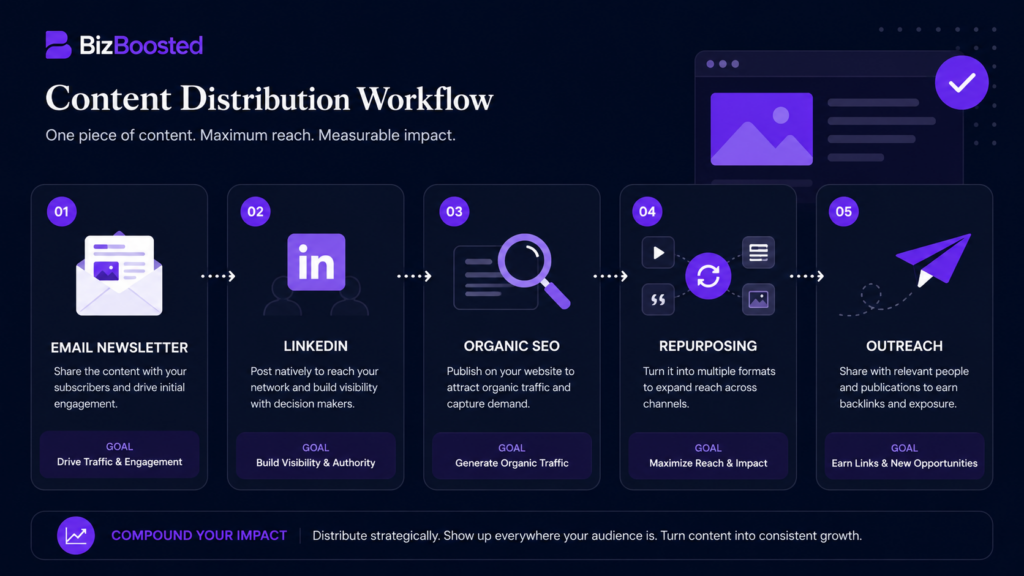
Modern B2B Content Marketing Strategy execution requires a multi-channel approach because buyers interact with brands across search engines, social platforms, email, communities, and AI interfaces. Businesses should avoid dependence on a single traffic source and instead create a coordinated distribution ecosystem.
Organic search remains a foundational channel because it captures existing demand. Publishing SEO-driven content aligned with buyer intent continues to generate sustainable traffic over time. However, distribution should extend beyond search into platforms where target audiences actively consume professional information.
LinkedIn has become particularly valuable for B2B marketing due to its business-oriented environment. Rather than sharing promotional posts, brands should repurpose educational insights into native content formats including short-form posts, carousels, thought leadership content, and executive commentary.
Email marketing continues to deliver strong returns when used strategically. Educational newsletters, resource roundups, industry insights, and nurture sequences help businesses maintain engagement with prospects across longer decision cycles. Distribution through email ensures content reaches audiences directly without relying entirely on algorithms.
Content repurposing should also become a standard operational process. A single long-form article can be transformed into multiple distribution assets including short videos, infographics, newsletters, podcasts, webinars, and social content. This approach increases reach while improving content production efficiency.
Businesses that treat distribution as a core component of strategy rather than an afterthought often achieve significantly stronger outcomes from the same content investment.
SEO and AI Search Optimization for B2B Brands
Search optimization in 2026 extends far beyond traditional keyword targeting. Businesses must optimize content for both search engines and AI-assisted discovery systems that synthesize information from multiple sources. A modern B2B Content Marketing Strategy therefore requires a broader approach focused on discoverability, credibility, and contextual relevance.
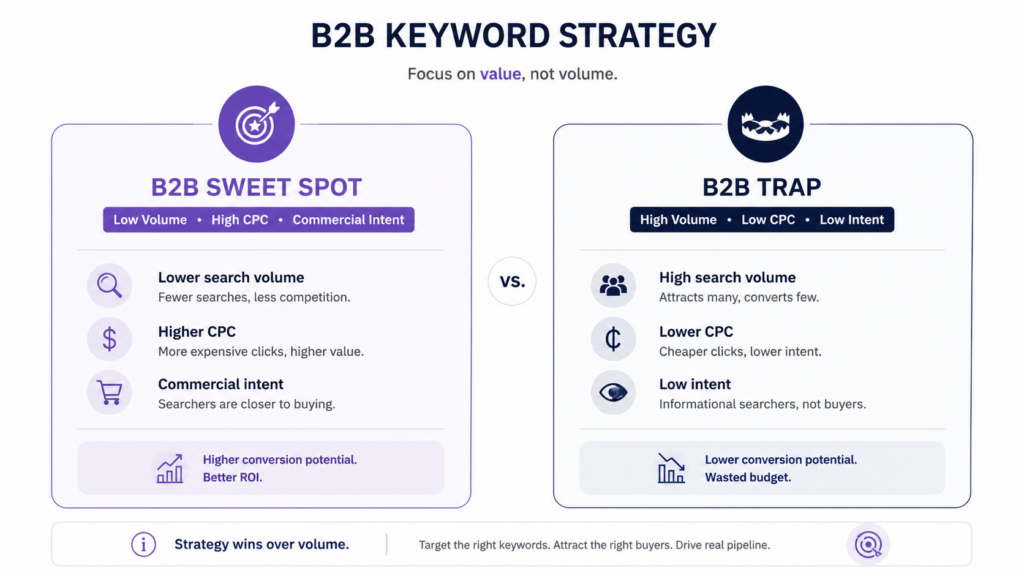
SEO still begins with understanding search intent. Businesses should map keywords to informational, commercial, and transactional stages of the buyer journey. Informational content builds awareness, while solution-oriented content supports evaluation and conversion. Content should address the complete decision process rather than targeting isolated phrases.
Semantic SEO has become increasingly important because search systems evaluate topic relationships and contextual understanding. Instead of repeating target keywords excessively, content should naturally incorporate related concepts, industry terminology, supporting questions, and real-world examples. This strengthens topical coverage and improves content comprehensiveness.
AI search optimization introduces additional requirements. Content must be structured clearly, answer questions directly, include original insights, and demonstrate authentic expertise. AI systems often prioritize pages that present useful explanations supported by practical knowledge rather than generic summaries.
EEAT plays a critical role in visibility. Businesses should showcase author expertise, cite real-world experiences, maintain transparent editorial standards, and support claims with evidence where appropriate. Case studies, expert commentary, and actionable examples increase content trustworthiness.
Technical performance remains essential. Fast-loading pages, mobile usability, strong internal linking, crawlability, structured content organization, and accessible page design continue supporting discoverability across both traditional and AI-powered search experiences.
The organizations winning in search today are those creating content that genuinely helps users rather than attempting to manipulate rankings.
Lead Generation and Conversion Optimization
Traffic alone does not produce business growth. Effective B2B content strategies are designed to convert attention into measurable business outcomes. This means connecting educational experiences with meaningful opportunities for engagement and lead capture.
Lead generation begins with understanding conversion intent. Different audiences require different entry points depending on their readiness level. Visitors in early research stages may engage with guides and educational assets, while buyers closer to decision stages may seek consultations, proposals, or solution comparisons.
Lead magnets remain highly effective when aligned with audience needs. Practical templates, frameworks, calculators, research reports, implementation guides, and checklists often outperform generic downloadable assets because they provide immediate value.
Calls to action should feel natural and contextually relevant. Aggressive promotional messaging can reduce trust and disrupt user experience. Instead, businesses should guide users toward logical next steps based on the content they are consuming.
Landing pages also play an important role in conversion performance. Effective pages communicate outcomes clearly, reduce friction, demonstrate credibility, and align messaging with audience expectations. Elements such as social proof, concise forms, transparent value propositions, and practical next steps support stronger conversion rates.
Conversion optimization should remain an ongoing process. Businesses should continuously test messaging, layouts, lead capture experiences, content placement, and user journeys. Small improvements in conversion efficiency often generate substantial business impact over time.
The most successful B2B brands understand that content and conversion strategy must operate together rather than as separate marketing activities.
Measuring Content Marketing Performance
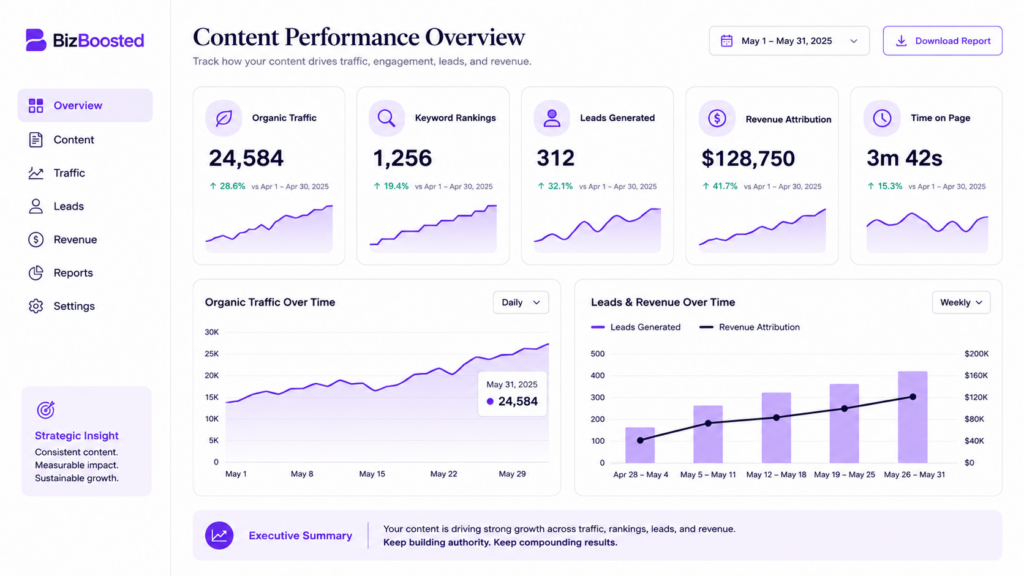
Without measurement, content marketing becomes guesswork. Organizations that consistently improve performance establish clear frameworks for tracking business outcomes instead of relying solely on vanity metrics.
Traffic remains useful but should not become the primary success indicator. High visitor numbers mean little if content fails to generate engagement, qualified leads, or revenue opportunities. Businesses should connect content performance directly to strategic objectives.
A comprehensive measurement framework typically includes visibility metrics, engagement metrics, conversion metrics, and revenue indicators. Organic impressions, rankings, click-through rates, time on page, lead submissions, sales opportunities, and customer acquisition all contribute valuable insights.
Content attribution has become increasingly important because B2B decisions often involve multiple touchpoints. Businesses should evaluate how content supports the entire buying journey rather than assigning success only to final conversion interactions.
Behavior analysis also provides useful optimization opportunities. Heatmaps, scroll tracking, engagement patterns, and navigation data help marketers identify where users lose interest or require additional support. These insights often reveal improvements that significantly increase performance.
Regular content audits should become part of operational workflows. Updating outdated information, improving internal links, refreshing examples, and expanding underperforming assets frequently produces better returns than creating entirely new content.
Businesses that measure strategically gain a stronger understanding of what drives results and can allocate resources more effectively over time.
Common B2B Content Marketing Mistakes to Avoid
Despite increasing investment in content marketing, many organizations continue making avoidable mistakes that limit performance. Recognizing these issues early helps businesses build more efficient and sustainable strategies.
One common mistake is creating content without a defined objective. Publishing articles simply to maintain consistency often results in low-value assets that generate limited business impact. Every piece of content should support awareness, engagement, lead generation, or customer success goals.
Another frequent issue is prioritizing quantity over quality. Large publishing volumes may appear productive but often weaken authority if the content lacks originality or usefulness. Businesses should focus on creating fewer but more valuable resources that solve real audience problems.
Ignoring distribution is another major limitation. Valuable content cannot perform if audiences never discover it. Effective promotion, repurposing, and channel diversification should be integrated into every publishing workflow.
Many organizations also underestimate the importance of updating content. Markets evolve quickly, and outdated information reduces credibility. Maintaining freshness demonstrates expertise and improves long-term performance.
Finally, businesses often overlook EEAT principles. Anonymous content, unsupported claims, and generic information reduce trust signals. Brands that showcase authentic expertise and practical experience typically achieve stronger visibility and engagement.
Avoiding these common mistakes creates a stronger foundation for sustainable growth and more consistent content performance.
Conclusion
Building a successful B2B Content Marketing Strategy in 2026 is no longer about publishing more content or chasing individual rankings. The brands creating sustainable growth today are those that combine audience understanding, strategic planning, SEO excellence, AI search readiness, and measurable business outcomes into one connected system.
A modern B2B Content Marketing Strategy should support the entire buyer journey—from awareness and consideration to conversion and retention. This requires more than blog publishing. It demands audience research, topical authority, multi-channel distribution, conversion optimization, performance measurement, and continuous improvement based on real user behavior.
The strongest content ecosystems are built with long-term thinking. Instead of creating isolated campaigns, successful organizations develop scalable content frameworks that continue attracting traffic, building credibility, and supporting revenue growth month after month.
At BizBoosted, we believe content should function as a business asset rather than a marketing task. When strategy, SEO, EEAT, and user value work together, content becomes one of the most reliable channels for long-term digital growth.
Businesses that invest in creating useful, experience-driven, and search-optimized content today will be better positioned to compete in the future of B2B marketing.
Ready to build a smarter content engine for 2026? Start by creating content that deserves visibility—not just content that targets it.
One of the biggest advantages of implementing a structured B2B Content Marketing Strategy is the ability to create predictable and scalable business growth over time. Instead of relying only on paid campaigns or short-term traffic spikes, businesses can build a sustainable content ecosystem that continuously attracts decision-makers. A successful B2B Content Marketing Strategy combines SEO, audience research, educational content, and conversion-focused experiences to improve visibility and trust. When executed consistently, a B2B Content Marketing Strategy becomes a long-term asset that supports brand authority, lead generation, and stronger customer relationships across both traditional and AI-powered search environments.
Conclusion
Building a successful B2B Content Marketing Strategy in 2026 is no longer about publishing more content or chasing individual rankings. The brands creating sustainable growth today are those that combine audience understanding, strategic planning, SEO excellence, AI search readiness, and measurable business outcomes into one connected system.
As search behavior continues evolving across Google and AI-powered discovery platforms, businesses must shift from content production to content authority. Buyers expect valuable insights, transparent expertise, and practical guidance before making decisions. Companies that consistently educate rather than promote are more likely to earn trust, strengthen brand positioning, and generate higher-quality opportunities over time.
At BizBoosted, we believe content should function as a business asset rather than a marketing task. When strategy, SEO, EEAT, and user value work together, content becomes one of the most reliable channels for long-term digital growth.
Businesses that invest in creating useful, experience-driven, and search-optimized content today will be better positioned to compete in the future of B2B marketing.
Ready to build a smarter content engine for 2026? Start by creating content that deserves visibility—not just content that targets it.
FAQs
What is a B2B Content Marketing Strategy?
A B2B Content Marketing Strategy is a plan to create and distribute content that attracts business customers, builds trust, and generates leads.
Why is B2B content marketing important in 2026?
It helps businesses improve visibility, educate buyers, build authority, and attract qualified leads across Google and AI search platforms.
How often should B2B companies publish content?
Quality matters more than quantity. Publishing consistent, high-value content two to four times per month is often effective.
What content works best for B2B marketing?
Blog articles, case studies, guides, whitepapers, videos, and educational resources usually perform well.
How does SEO support B2B content marketing?
SEO improves discoverability, helps target buyer intent, and increases organic traffic and lead opportunities.
How can businesses optimize for AI search?
Create clear, trustworthy, experience-based content with strong structure and direct answers.
What is the biggest content marketing mistake?
Publishing content without a strategy, audience research, or clear business goals.