By BizBoosted Team · Updated June 2026 · 12 min read
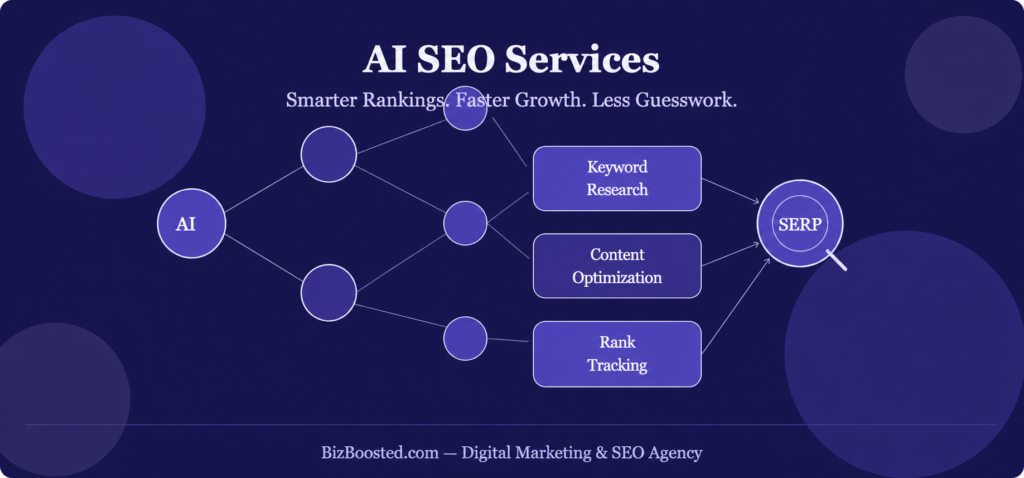
Quick Summary: AI SEO service is transforming how businesses rank on Google, appear in ChatGPT results, and convert organic visitors into paying customers. This guide breaks down exactly what it is, how it works, what results to expect, and how to choose the right service for your business in 2026.
Table of Contents
- What Is an AI SEO Service (And Why It Matters in 2026)
- How AI Has Changed the Way Google Actually Ranks Content
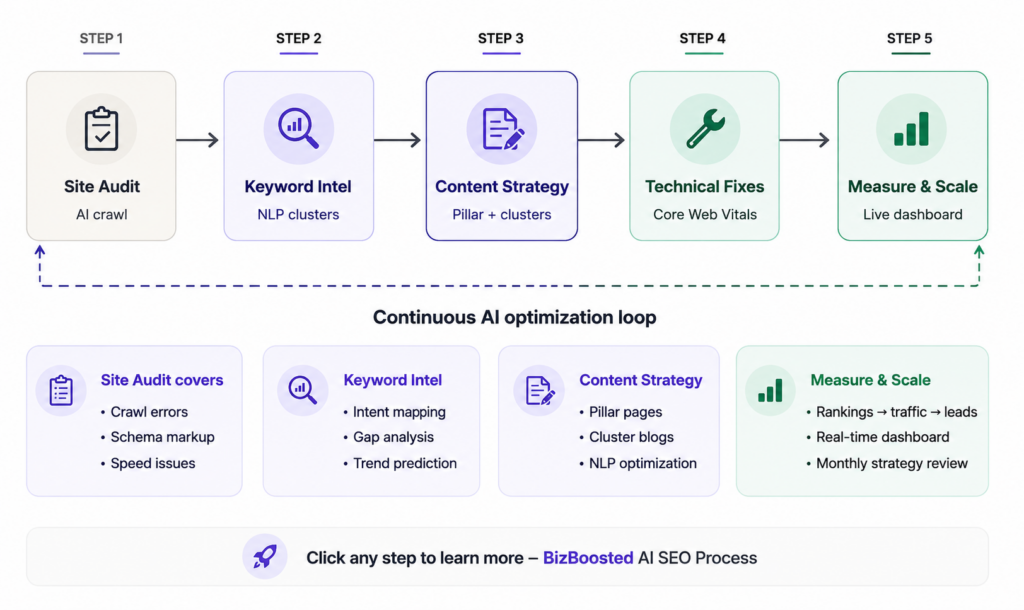
- Core Components of a High-Performing AI SEO Service
- AI SEO for Small Business: A Different Playbook That Actually Works
- Content Strategy Powered by Artificial Intelligence
- AI-Driven Technical SEO: Finding Problems Before They Tank Your Rankings
- Link Building in the Age of AI: Quality, Relevance, and Scale
- GEO: Optimizing for ChatGPT, Gemini, and Perplexity (The New Frontier)
- Measuring Real ROI from an AI SEO Service
- How to Choose the Right AI SEO Service for Your Business
- The Future of AI SEO: What 2026 and Beyond Looks Like
- Frequently Asked Questions
What Is an AI SEO Service (And Why It Matters in 2026)
Search engine optimization has never stood still, but what is happening in 2026 is not just evolution — it is a full category shift. Businesses that once relied on spreadsheets and manual audits are now navigating a landscape where artificial intelligence does the heavy analytical lifting. An AI SEO service is no longer a luxury reserved for enterprise brands. It has become the operating standard for any small or mid-size business that wants to compete seriously in Google search, AI-powered discovery engines, and voice queries.
At BizBoosted, we work with small business owners who ask the same foundational question daily: is AI-driven SEO actually worth it, or just another buzzword? The honest answer, backed by real client results, is that AI SEO is not about replacing strategic thinking — it is about compressing execution time while dramatically improving the accuracy of every decision. When implemented correctly, it becomes the most powerful growth lever a small business can pull.
An AI SEO service uses machine learning, natural language processing, and predictive data models to plan, execute, and continuously improve a website’s search performance. Unlike traditional SEO — which depends on a strategist manually pulling data over months — an AI-powered approach processes thousands of data points simultaneously, surfacing insights that a human analyst could take weeks to uncover. The difference is not just speed; it is the depth and accuracy of the intelligence applied to every decision.
How AI Has Changed the Way Google Actually Ranks Content
To understand why an AI SEO service matters right now, you need to understand what is happening on the search engine side. Google has been an AI company at its core for years — RankBrain in 2015, BERT in 2019, MUM after that. Now, generative AI layers integrated directly into Google Search have fundamentally changed how queries are interpreted and content evaluated. Search engines are no longer matching keywords to pages — they are understanding the full contextual meaning of a query and looking for content that comprehensively addresses the topic behind it.
This shift toward semantic search means the old playbook of stuffing a target keyword into titles and body text at calculated density no longer produces reliable results. What works now is demonstrating genuine expertise across a topic cluster, satisfying the full range of user intent, and maintaining quality signals that AI-driven ranking systems are increasingly good at detecting. Google’s Helpful Content system actively penalizes content that exists primarily to rank rather than to inform — and SEO practitioners have only recently had to build their entire strategies around that reality.
Core Components of a High-Performing AI SEO Service
Not all AI SEO services are built the same, and understanding what the best ones include is essential before you invest. The highest-performing services combine several distinct capability areas, each powered by machine learning in ways traditional tools cannot replicate.
The first component is AI-powered keyword research and opportunity mapping — going far beyond volume and competition scores. Advanced AI systems cluster keywords by intent, group them into topic pillars, identify emerging trends before they peak in standard tools, and map the full semantic landscape. Where a traditional tool shows you 50 keywords with volume data, an AI system shows you how those keywords relate to each other, which signal buying intent versus research intent, and which content gaps represent the highest-opportunity entry points for your domain authority level.
The second is technical SEO analysis at scale: AI crawlers assess your entire site structure, Core Web Vitals, crawlability issues, duplicate content, and internal linking gaps simultaneously — prioritizing fixes by impact. The third is content intelligence, using NLP models to analyze what top-ranking content actually contains semantically, then guiding content creation to match and exceed that benchmark. The fourth, increasingly critical in 2026, is AI citation optimization — structuring your content to be cited by ChatGPT, Gemini, and Perplexity. Research shows that while AI platforms drive under one percent of raw traffic, they generate disproportionately high-quality leads with significantly above-average conversion rates.
AI SEO for Small Business: A Different Playbook That Actually Works
Small businesses operate with fundamentally different constraints than large enterprises. Enterprise SEO is largely about maintaining an enormous existing presence across thousands of pages. Small business SEO is about building authority efficiently in a defined geographic or niche market, converting high-intent local searches, and making every content piece work harder because you cannot produce volume at enterprise scale.
AI changes the economics of this in ways that genuinely favor small businesses. A local restaurant group, a regional law firm, or a specialty e-commerce retailer can now access keyword clustering, competitor gap analysis, and content optimization guidance previously available only to brands with large in-house SEO teams. The AI systems do not care about the size of your domain — they analyze what it would take to move your specific site up in your specific competitive landscape and generate a roadmap calibrated to your actual starting point.
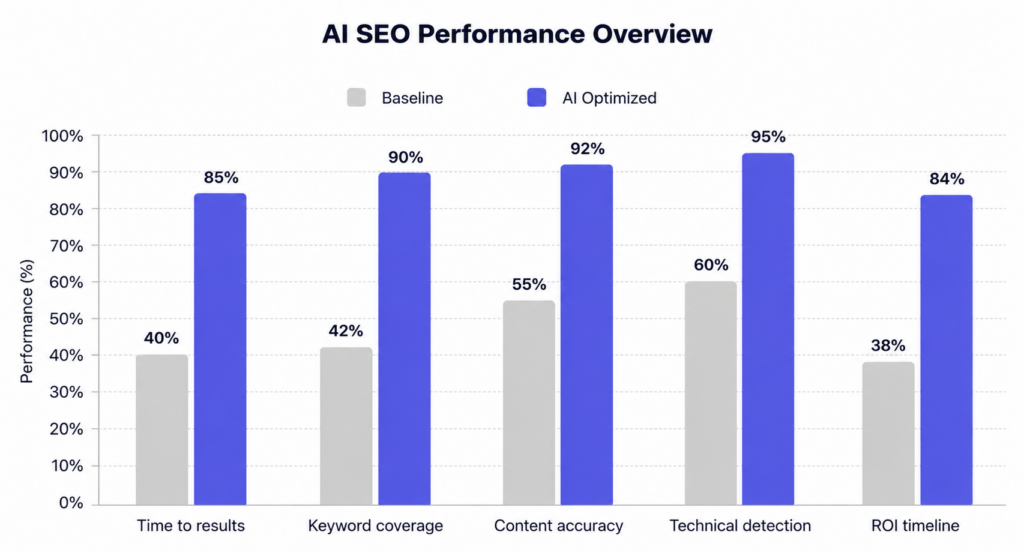
A small business using a quality AI SEO service can achieve meaningful ranking improvements within three to four months, rather than the six to twelve month runway traditional SEO typically requires. The acceleration comes from eliminating the trial-and-error phase — the AI identifies which actions will have the highest impact and in what sequence, deploying resources against opportunities with the clearest return from day one. A practical example: a small dental practice can identify in weeks that “emergency dentist open Saturday” and “affordable dental implants near me” represent lower-competition, high-conversion opportunities — and build a strategy specifically targeting those intent clusters with precision that generic SEO advice simply cannot match.
Content Strategy Powered by Artificial Intelligence
Content has always been the foundation of effective SEO, but how content strategy is developed has been transformed by AI. The traditional approach — picking a handful of keywords, writing articles, hoping they rank — is categorically different from an AI-driven approach that maps every question your target audience is asking at every stage of their decision journey and builds a content architecture that systematically establishes your site as the authoritative resource.
Natural language processing tools in advanced AI SEO services analyze thousands of search queries simultaneously, identify intent patterns, and cluster them into content opportunities mapped to specific pages on your site. This eliminates the content cannibalization problem — where multiple pages compete for the same query, splitting authority and weakening all of them — by ensuring every page targets a distinct intent cluster. It also surfaces the semantic entities and related concepts that must appear in your content for Google’s AI systems to recognize your page as genuinely comprehensive.
Consider how this plays out for a digital marketing agency blog. An AI content audit might reveal twelve articles all partially targeting “social media marketing tips,” none ranking well because they split authority across each other. The AI identifies this cannibalization, recommends consolidating the strongest material into a single pillar piece, and maps cluster articles for distinct long-tail queries. The result is a content architecture that builds cumulative topical authority rather than diluting it — and the difference between a random editorial calendar and this AI-structured approach can mean the difference between a few hundred monthly visitors and tens of thousands within eighteen months.
AI-Driven Technical SEO: Finding Problems Before They Tank Your Ranking
Technical SEO is the unglamorous backbone of search performance, and it is also the area where AI-powered tools have made the most dramatic improvements in speed and accuracy. A manual technical audit on a medium-sized website might take several days and still miss issues buried in JavaScript rendering or complex URL structures. An AI-powered crawler can assess the same site in hours, categorize every issue by severity and impact, and generate a prioritized remediation plan before a human expert has opened a spreadsheet.
Core Web Vitals metrics — Largest Contentful Paint, Interaction to Next Paint, and Cumulative Layout Shift — require analysis across different device types and connection speeds that AI tools model at scale, pinpointing the specific elements causing degradation. For small businesses using WordPress with Elementor, AI-powered audit tools integrate directly with your CMS and identify performance issues in real time as content is published — catching problems before they go live rather than diagnosing them after rankings drop.
Schema markup is another area where AI-driven technical SEO delivers outsized value. As Google increasingly uses structured data to populate AI Overviews, rich results, and featured snippets, having correct schema across every page type has moved from nice-to-have to essential. AI tools can audit your entire site’s schema implementation, identify missing or incorrect markup, and generate the correct structured data at scale — a task that manual implementation across hundreds of pages would make prohibitively time-consuming for most small businesses.
Link Building in the Age of AI: Quality, Relevance, and Scale
Link building remains one of the most significant ranking factors in Google’s algorithm, and one of the areas most transformed by AI-powered tools. The basic principle has not changed — you need authoritative, relevant sites linking to your pages for those pages to rank competitively. What has changed is how efficiently the entire link acquisition process can be executed when AI is applied to prospect identification, outreach personalization, and opportunity prioritization.
Traditional link building required manually researching potential partners, assessing domain metrics, crafting individual outreach emails, and managing follow-up sequences across dozens of prospects. AI-powered link building tools analyze your competitor backlink profiles, identify the specific types of sites most likely to link to content in your niche, score prospects by relevance and authority, and generate personalized outreach templates calibrated to each target’s content focus — sustaining dramatically higher volume and quality than manual processes can support.
AI does not change the fundamental quality standards that make link building effective, though. Google’s systems are increasingly sophisticated at identifying manufactured or manipulative link patterns. The most effective AI SEO services use artificial intelligence to scale genuine relationship-based link acquisition — finding real partnership opportunities, identifying guest posting venues aligned with your expertise, and supporting digital PR campaigns that earn editorial coverage. A BizBoosted client in home improvement used AI-assisted outreach to identify 47 local news and home decor publications that regularly link to expert contractor content — a prospect list that would have taken weeks to compile manually.
GEO: Optimizing for ChatGPT, Gemini, and Perplexity (The New Frontier)
One of the most significant developments in search behavior is the growing volume of queries being handled not by Google but by large language model interfaces — ChatGPT, Google Gemini, Microsoft Copilot, and Perplexity. While these platforms currently drive a small fraction of total web traffic, the quality of that traffic is disproportionately high. Leads arriving from AI-generated citations convert at significantly higher rates than standard organic traffic, because users who receive a specific AI recommendation are much further along in their decision process.
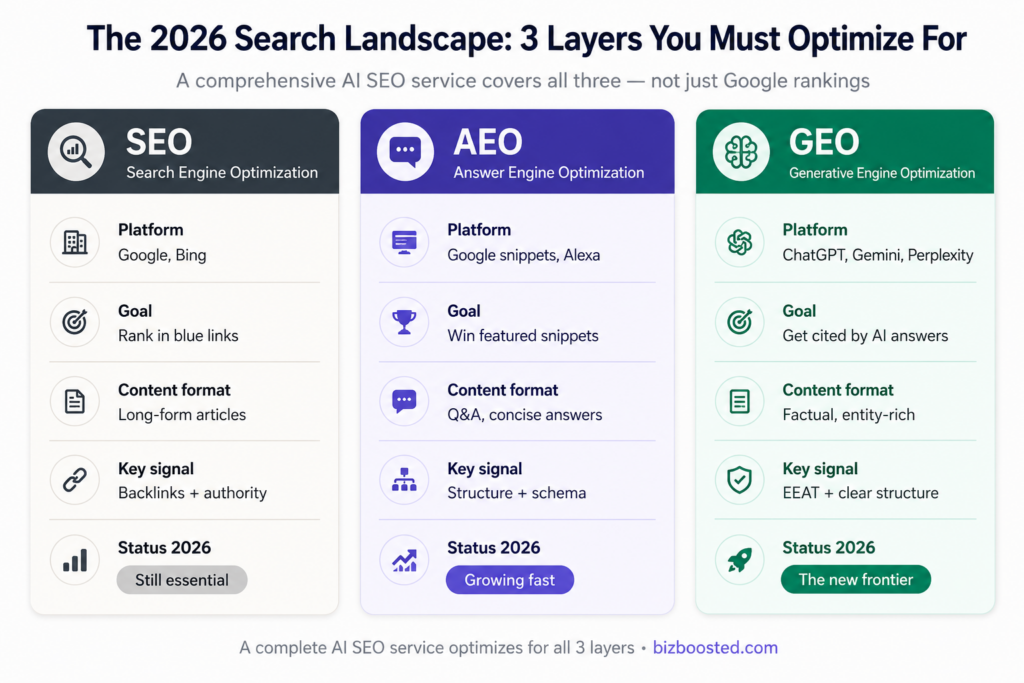
Generative Engine Optimization (GEO) is the emerging practice of structuring your content to be cited and surfaced by these AI systems. The principles are distinct from traditional SEO — AI systems do not rank pages by authority score, they synthesize information from sources they assess as credible and clearly authoritative. Content optimized for GEO needs clear factual structure that can be easily extracted, explicit EEAT signals, comprehensive topical coverage with specific data points, and schema markup that communicates structure to machine reading systems.
For a digital marketing agency like BizBoosted, GEO optimization means structuring blog content so that when a business owner asks ChatGPT “what is the best AI SEO service for small businesses,” our content is positioned as a credible citation source. This requires going beyond keyword optimization into entity optimization — ensuring our brand, authors, and areas of expertise are clearly established in structured, crawlable content. The businesses investing in this layer now are building a compounding citation advantage that will become increasingly valuable as AI-assisted search continues to grow.
Measuring Real ROI from an AI SEO Service
Demonstrating clear ROI from SEO to business owners accustomed to paid advertising — where every dollar traces to a click — requires a different framework. That framework must account for the compounding nature of organic search investment and the lifetime value of traffic that continues generating without ongoing per-click cost.
The metrics that actually matter start with organic traffic growth — not just total sessions, but qualified traffic from searches with clear commercial intent. Ranking improvement across your target keyword clusters matters, but only in the context of traffic and conversion impact, not as a standalone vanity metric. Organic conversion rate, lead volume from organic channels, and revenue attributed to organic traffic are the numbers that connect SEO performance to business outcomes in a way that justifies continued investment.
A useful benchmark framework: in months one through three, look for technical improvement metrics — crawl errors resolved, Core Web Vitals improving, indexation rates increasing. In months three through six, look for early ranking movements on lower-competition queries and initial traffic growth on newly optimized pages. In months six through twelve, look for meaningful traffic volume increases and organic conversion data confirming commercially relevant traffic. AI-powered reporting dashboards make this measurement layer significantly more transparent — connecting ranking changes to traffic movements to conversion data in near real-time, rather than a monthly PDF with limited context.
How to Choose the Right AI SEO Service for Your Business
The market for AI SEO services has expanded rapidly, and quality variation between providers is significant. There are genuinely transformative services built on proprietary AI systems, and there are agencies that have added “AI-powered” to their marketing without meaningfully changing their delivery. Knowing how to distinguish between the two is essential before committing a budget.
The first thing to evaluate is transparency about methodology. A credible AI SEO service explains specifically which AI tools and models they use, what data sources they analyze, and how their process differs from traditional SEO. Vague claims about “AI-driven insights” without explanation of the actual workflow are a warning sign. The second factor is reporting quality — AI tools generate large volumes of data, and a good service translates that data into clear, actionable strategic guidance rather than raw data dumps requiring a data scientist to interpret.
Ask prospective providers five specific questions before signing. Which specific AI platforms are integrated into your workflow? Can you show me examples of keyword clustering or content gap reports your AI generates? How do you prioritize technical SEO issues — which do you address first and why? How do you connect SEO activity to business outcomes like leads and revenue? Can you provide references from clients in a similar industry? The specificity of answers to these questions will tell you more about actual capability than any marketing material or case study.
The Future of AI SEO: What 2026 and Beyond Looks Like
The trajectory of AI in search and SEO is accelerating, and businesses that build digital marketing foundations around AI-compatible strategies now will have substantial advantages over those that adapt later. The integration of generative AI into search results — Google’s AI Overviews, Bing’s Copilot integration, and growing search behavior within ChatGPT and Perplexity — is creating optimization work that goes beyond ranking in traditional blue-link results. Appearing in AI-generated summaries requires clear factual structure, strong EEAT signals, well-organized schema markup, and topical depth that makes your content a reliable source for AI systems to draw from and cite.
Predictive SEO — using AI to anticipate search demand before it peaks rather than reacting to existing volume data — will also become a standard capability of leading services. Businesses that invest in building content ahead of emerging demand curves will capture organic traffic at the moment of highest growth potential, compounding their authority advantage while competitors are still identifying the opportunity. Voice search optimization, multi-modal content strategies, and brand entity establishment in knowledge graphs are all areas where AI SEO services will expand their scope over the next twelve to twenty-four months. The future of SEO belongs to those who use AI not just to optimize the present, but to strategically position for what is coming next.
Conclusion
The rise of AI SEO service as a mainstream capability is not a passing trend — it is the new baseline for competitive search performance in 2026 and beyond. Small businesses that engage with AI-driven SEO now, while competitors are still operating on traditional frameworks, are building an organic authority advantage that will compound significantly over time. Faster insight generation, more precise content strategy, proactive technical optimization, dynamic adaptation to algorithm changes, and GEO positioning for AI-powered search make this the most efficient path to sustainable organic growth available today.
At BizBoosted, everything we do in the SEO space applies the most powerful available analytical tools to small business marketing challenges that enterprise-focused solutions have historically underserved. The businesses winning in search right now are not necessarily the biggest or the best-funded — they are the ones making smarter strategic decisions, faster. That is exactly what a quality AI SEO service is designed to enable, and the standard we hold ourselves to every day.
Frequently Asked Questions
What exactly does an AI SEO service include?
An AI SEO service typically includes AI-powered keyword research and topic clustering, technical site analysis using machine learning-based crawl tools, content optimization guidance informed by natural language processing, backlink profile analysis and link opportunity identification, competitor intelligence modeling, and performance reporting dashboards that connect rankings to traffic and conversions. The specific scope varies by provider and pricing tier, so request a detailed breakdown of deliverables before engaging any service. The best providers will show you not just which tools they use but how those tools integrate into a coherent strategic workflow customized to your specific business goals.
How is an AI SEO service different from traditional SEO?
Traditional SEO relies on manual analysis, human-driven keyword research, and strategies built on general best practices applied over long time horizons. An AI SEO service uses machine learning to analyze far larger datasets, identify patterns invisible in standard analytics views, predict outcomes with greater accuracy, and execute optimization actions at a speed and scale that manual processes cannot match. The strategic intent is the same — improve organic visibility and drive qualified traffic — but the intelligence layer, execution efficiency, and quality of insight are substantially different. AI-driven services also adapt more dynamically to algorithm changes because the systems detect shifts in ranking patterns faster than human monitoring can.
How long does it take to see results from an AI SEO service?
Meaningful ranking improvements typically begin appearing within three to six months, with more substantial traffic growth becoming visible in the six to twelve month window. What AI acceleration delivers is faster identification of high-opportunity actions and a more efficient early implementation phase — technical fixes that would take months to diagnose manually can be identified and implemented in weeks, and content targeting is more precise from the start. The trajectory of improvement tends to be steeper once momentum builds, because AI-informed content architecture compounds authority more efficiently than content produced on instinct.
Is an AI SEO service worth it for a small business with a limited budget?
Yes, for most small businesses in competitive markets, the ROI justifies the investment. The key is ensuring the service is appropriately scoped for a small business — not an enterprise package repackaged at a lower price — and that the provider has a genuine track record with businesses of similar size. Organic search traffic, once built, continues generating leads and sales without ongoing per-click costs. Compared to equivalent spend on paid advertising, quality SEO typically produces higher-value traffic and a lower blended cost per acquisition over a twelve to twenty-four month horizon.
Will AI SEO still work if Google keeps updating its algorithm?
AI SEO strategies built on the right principles — comprehensive topical authority, high-quality content satisfying real user intent, strong technical foundations, and legitimate link acquisition — are more resilient to algorithm changes, not less. The businesses most vulnerable to algorithm updates are those built on gaming specific signals. AI-powered services built on genuine quality signals trend in the opposite direction, and the AI systems continuously monitor ranking signal patterns, detecting when algorithm behavior shifts and allowing for faster strategic adaptation than traditional monitoring.
Can AI-generated content rank well on Google in 2026?
The highest-performing SEO content in 2026 combines AI-powered research and structural guidance with human expertise in writing and subject matter depth. Pure AI-generated content without meaningful human editing often lacks the specificity, credibility, and authentic perspective that both users and Google’s Helpful Content systems evaluate. The strongest approach uses AI to identify what a piece of content needs to contain, what intent it needs to serve, and what semantic coverage it requires — then has skilled human writers execute against that blueprint. This hybrid approach consistently outperforms both pure AI generation and purely intuition-driven human writing.
What is the difference between SEO, AEO, and GEO?
SEO (Search Engine Optimization) focuses on ranking in traditional Google results. AEO (Answer Engine Optimization) focuses on structuring content to be featured in direct answer formats — featured snippets, voice search responses, and knowledge panels. GEO (Generative Engine Optimization) is the emerging practice of optimizing content to be cited by AI-powered interfaces like ChatGPT, Gemini, and Perplexity. A comprehensive AI SEO service in 2026 addresses all three layers, because the search landscape is no longer a single channel — it is a distributed ecosystem of discovery surfaces each requiring specific optimization approaches.
How do I know if an agency is genuinely using AI or just rebranding traditional SEO?
Ask specific questions about tools and processes. A legitimate AI SEO service can identify the AI platforms they use, explain how machine learning is applied in their keyword research and content strategy, and show you examples of data-driven recommendations their AI analysis generates. They should also demonstrate how their reporting goes beyond standard Google Analytics and Search Console data to surface insights those platforms alone would not reveal. If answers are vague or the “AI” component turns out to be primarily standard automation tools relabeled with buzzwords, the service is marketing-forward and capability-light.