By BizBoosted Team · Updated June 2026 · 17 min read
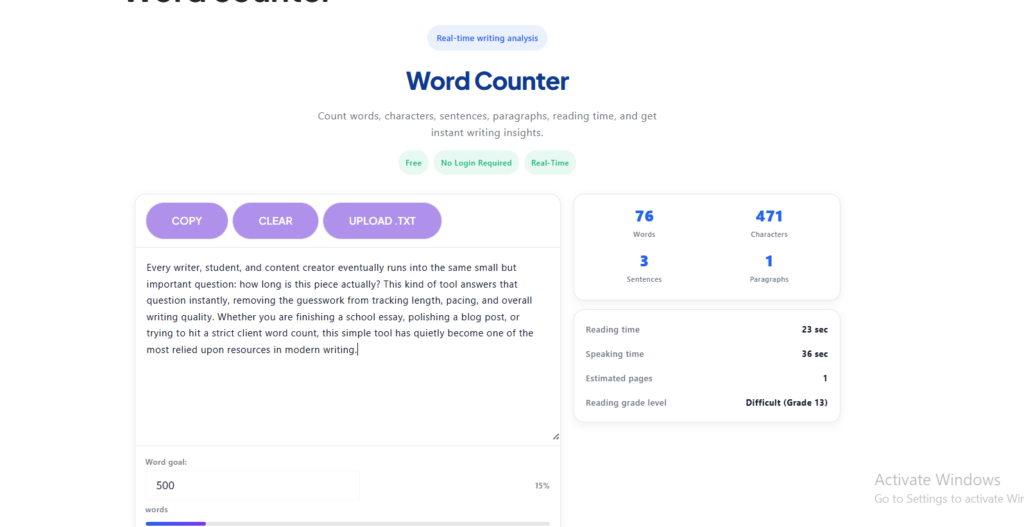
Every writer, student, and content creator eventually runs into the same small but important question: how long is this piece actually? This kind of tool answers that question instantly, removing the guesswork from tracking length, pacing, and overall writing quality. Whether you are finishing a school essay, polishing a blog post, or trying to hit a strict client word count, this simple tool has quietly become one of the most relied upon resources in modern writing.
In this article, we will explore exactly what this kind of tool does, why it matters far more than most people initially assume, and how the right resource can genuinely improve your writing process from start to finish. Along the way, we will also look at BizBoosted’s own free Word Counter, a tool built specifically to give writers real-time insight into their work without any sign-up or hidden cost involved.
What Is a Word Counter
A word counter is a digital tool designed to instantly measure how many words, characters, sentences, and paragraphs exist within a piece of text. Instead of manually counting words one by one, which is both tedious and prone to error, a writer can simply paste or type their content into the tool and receive an accurate count within seconds, saving real time during every stage of the writing process.
Modern versions of this tool have evolved well beyond a simple number on a screen. Many now include additional writing insights such as estimated reading time, speaking time, reading grade level, and even keyword density breakdowns, turning a basic counting utility into a genuinely useful writing analysis companion that supports far more than just length tracking alone, especially for anyone juggling multiple drafts at once.
How a Word Counter Works
At a technical level, this kind of tool scans the text a user enters and applies straightforward rules to identify word boundaries, typically based on spaces and punctuation. Once words are identified, the system tallies the total, while simultaneously calculating related metrics like character count, sentence count, and paragraph breaks based on similar pattern recognition applied consistently throughout the text.
More advanced platforms layer additional calculations on top of this basic counting process. Reading time estimates, for example, are usually generated using an average reading speed applied to the total word count, while keyword density calculations track how frequently specific words or phrases appear relative to the overall length of the piece, giving writers a much clearer picture of repetition and balance throughout their work.
Why Writers and Students Rely on a Word Counter
Writers across nearly every discipline depend on accurate word counts to meet specific requirements, whether that means a strict essay length set by a professor or a flexible target suggested by an editor. Without this kind of resource, tracking length manually becomes both time-consuming and unreliable, especially across longer documents where miscounting is extremely easy to do by hand, particularly once a document stretches beyond a few short paragraphs.
Students in particular benefit from this kind of tool throughout their academic careers, since assignments frequently come with firm minimum or maximum word requirements. Relying on a dependable counting resource allows students to focus their attention on the actual quality of their argument or analysis, rather than repeatedly pausing to estimate whether they have written enough or, just as commonly, written far too much for the assignment at hand.
Word Counter for Content Creators and Marketers
Content creators and digital marketers represent another major group that depends heavily on accurate word counting throughout their daily workflow. Blog posts, social media captions, and SEO content all tend to perform best within specific length ranges, and a dependable counting tool makes it easy to stay within those targets without constantly second-guessing the current length of a draft mid-way through writing.
Marketers writing ad copy or email campaigns also rely on precise counting, since many platforms enforce strict character limits that cannot be exceeded without the content being cut off or rejected entirely. A reliable tool that also tracks character count alongside word count becomes especially valuable in these situations, helping creators stay within platform-specific constraints while still delivering a clear, persuasive message that lands exactly as intended.
Word Counter for Academic and Professional Writing
Academic writing often comes with some of the strictest length expectations of any writing category, particularly for research papers, theses, and formal submissions tied to publication guidelines. A dependable word counter ensures that writers stay within these defined boundaries, preventing the frustration of submitting work that technically violates length requirements despite strong underlying content and careful research, which can otherwise lead to unnecessary rejection or revision requests from reviewers and committees.
Professionals drafting reports, proposals, or official documentation face a similar challenge, since many corporate and government submissions include explicit length restrictions tied to formatting standards or review processes. Using a trustworthy counting tool throughout the drafting process helps professionals avoid last-minute trimming or padding, allowing them to write naturally while still landing comfortably within whatever length parameters the situation requires.
Who Should Use a Word Counter Regularly
Beyond the obvious categories of students and professional writers, a surprisingly wide range of people benefit from checking their word count regularly, often without realizing how much it streamlines their daily routine. Freelancers billing by the word need precise figures to invoice clients accurately, while public speakers preparing remarks often use word counts paired with speaking time estimates to gauge whether a speech fits comfortably within an allotted slot.
Social media managers and email marketers also fall into this category, since both platforms reward concise, well-structured messaging that respects strict character or word limits. Even casual writers keeping a journal or working on a personal blog often find value in checking their word count simply to understand their own writing habits and patterns over time, which can reveal useful insights about pacing and consistency.
Best Free Word Counter Tool
If you are looking for a tool that goes beyond a simple number, BizBoosted’s Word Counter is built to give writers genuinely useful, real-time insight into their work. It is completely free, requires no login, and updates instantly as you type or paste content directly into the interface, making it one of the more practical options available for everyday writing tasks of every kind.
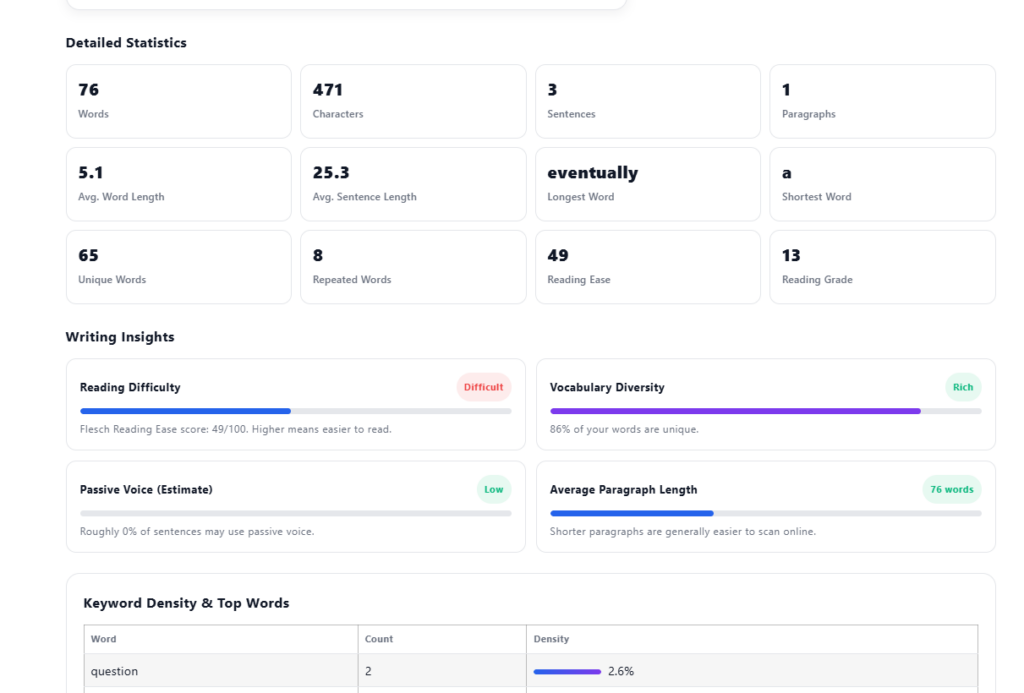
What makes this particular tool stand out is the depth of detail provided alongside the basic count. Beyond words, characters, sentences, and paragraphs, it also calculates reading time, speaking time, estimated page count, and reading grade level, giving writers a much fuller picture of how their content will actually be experienced by a reader rather than just how long it technically is on paper.
Key Features of BizBoosted’s Word Counter
One standout feature is the built-in keyword density and top words breakdown, which shows exactly how often specific words appear throughout a piece of writing. This is particularly useful for content creators focused on SEO, since it allows them to quickly check whether a target keyword has been used naturally or whether certain words are being repeated too frequently throughout the text without them realizing it.
The tool also includes a word goal tracker, allowing writers to set a target length and watch their progress toward that goal update in real time as they write. Additional conveniences like uploading a text file directly, copying a quick summary, downloading results as a TXT file, or printing the full breakdown as a PDF make this tool a flexible option for writers who want more than just a basic count displayed on screen.
How to Use a Word Counter Effectively
Using a counting tool effectively starts with understanding which metrics actually matter most for your specific task. A student focused purely on hitting an essay’s word requirement might only need the basic count, while a content marketer optimizing a blog post for search engines will likely want to pay closer attention to keyword density and reading time estimates as well throughout the editing process.
It also helps to check your word count throughout the writing process rather than only at the very end. Monitoring length as you draft makes it far easier to adjust pacing naturally, whether that means expanding a thin section earlier rather than scrambling to add filler at the last minute, or recognizing early that a section has grown too long and needs tightening before moving forward with the rest of the piece.
Common Mistakes Writers Make Without a Word Counter
One common mistake writers make without consistent access to this kind of tool is dramatically misjudging the length of their own work. It is surprisingly easy to assume a draft is shorter or longer than it actually is, especially across multiple editing sessions, which often leads to unpleasant surprises when a final count reveals the piece falls well outside an intended range.
Another frequent issue involves uneven pacing throughout longer documents, where certain sections become disproportionately long compared to others without the writer fully realizing it. Without a reliable way of tracking paragraph and section length alongside the overall total, this kind of imbalance can go unnoticed until a reader or editor points it out, at which point fixing the structure becomes considerably more difficult than catching the issue early on.
Word Counter vs Manual Counting
Some writers still attempt to estimate word count manually, either by counting lines and multiplying by an average words-per-line figure or by relying on rough mental approximations built from years of experience. While this might work occasionally for very short pieces, it becomes increasingly unreliable as document length grows, often producing estimates that are noticeably off from the actual final total.
A digital counting tool removes this guesswork entirely, providing an exact, verified count within seconds regardless of document length. Beyond simple accuracy, automated tools also save considerable time compared to manual counting, freeing writers to focus their energy on refining content quality rather than performing repetitive, error-prone arithmetic throughout the entire editing process, which ultimately leaves far more room for actual creative thinking and revision.
How a Word Counter Supports Better Overall Writing
Beyond simple length tracking, a good counting tool can genuinely improve the overall quality of a piece of writing by surfacing patterns that might otherwise go unnoticed. Reading grade level indicators, for example, help writers gauge whether their language matches the intended audience, which is especially valuable for content meant to be accessible to a broad, general readership rather than a specialized expert group with technical vocabulary.
Keyword density tracking offers a similar benefit for anyone writing with search visibility in mind, helping ensure that important terms appear often enough to support relevance without tipping into unnatural repetition that could hurt both readability and search performance. Together, these additional insights transform a simple counting tool into a meaningful part of a writer’s broader quality control process from first draft to final edit.
Tips for Getting More Value From a Word Counter
Getting the most out of this kind of tool usually comes down to checking it consistently rather than only glancing at it once a draft feels finished. Building the habit of reviewing your count, reading time, and grade level at regular intervals throughout the writing process tends to produce far more balanced, polished results than a single check performed right before submission or publication.
It also helps to pay attention to more than just the raw total. Reviewing keyword density alongside reading grade level can reveal whether a piece reads naturally for its intended audience while still supporting search visibility goals, which is especially valuable for anyone writing content meant to perform well both with readers and with search engines at the same time.
Word Counter and SEO Content Length
Search engines tend to favor content that thoroughly covers a topic, and many SEO tools, including popular WordPress plugins, evaluate articles partly based on overall length alongside keyword usage and readability scores. Knowing the exact length of a draft in real time makes it much easier to hit the target range these plugins recommend, rather than guessing and repeatedly switching back and forth between an editor and a separate analysis tool just to check progress.
Pairing length tracking with a built-in keyword density breakdown adds even more value for this exact purpose. Writers can confirm that a focus keyword appears often enough to support relevance without crossing into the kind of unnatural repetition that search engines and SEO plugins alike tend to flag as a quality issue, allowing a piece to satisfy both length and optimization requirements at the same time.
Conclusion
A reliable word counter solves a problem nearly every writer eventually encounters, turning a tedious, error-prone counting task into something instant and effortless. From students managing strict essay requirements to marketers optimizing content for search engines, the simple act of tracking word count accurately supports better pacing, stronger structure, and ultimately more polished final work across nearly every type of writing imaginable.
You may also read this blog
FAQs
What does a word counter actually measure
It measures total words, and usually also tracks characters, sentences, paragraphs, reading time, and keyword density.
Is BizBoosted’s Word Counter free to use
Yes, it is completely free with no login or sign-up required.
Can a word counter help with SEO content writing
Yes, keyword density tracking helps confirm a target keyword is used naturally without overdoing it.
How accurate is an online word counter compared to manual counting
Far more accurate, since it relies on consistent scanning logic instead of human estimation.
Does a word counter calculate reading time as well
Many advanced tools do, estimating both reading time and speaking time from the total word count.
Can I upload a document directly instead of typing or pasting text
Yes, several tools allow direct file uploads, such as a text file, for quick analysis.
Why does reading grade level matter when checking word count