By BizBoosted Team · Updated June 2026 · 8 min read
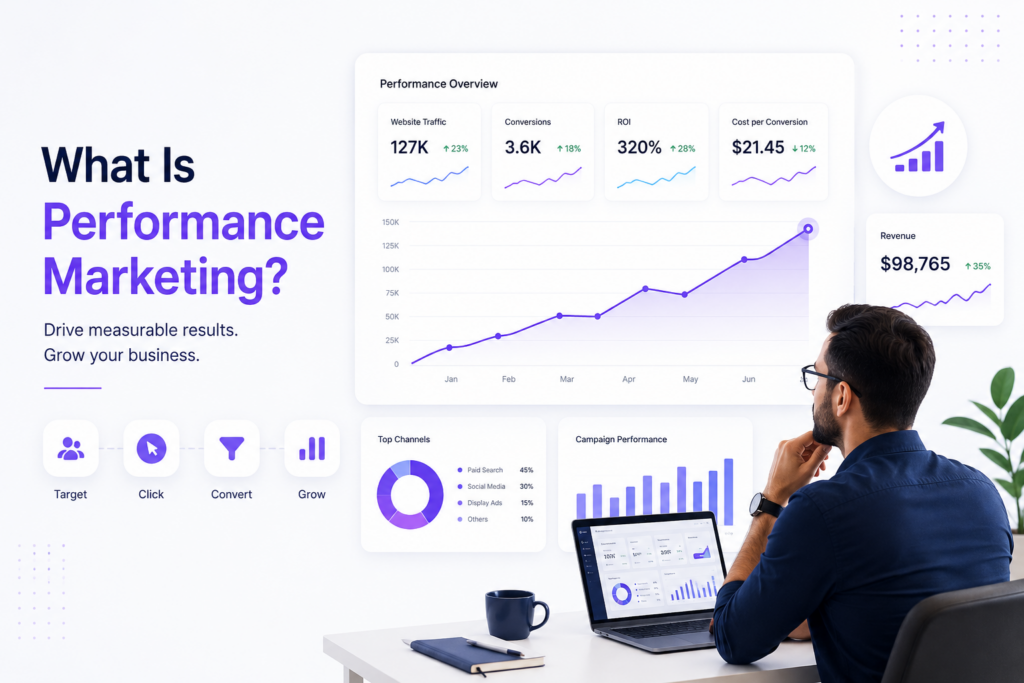
Table of Contents
- Introduction
- What Is Performance Marketing?
- How Performance Marketing Works
- Popular Performance Marketing Channels
- Key Metrics That Matter
- Performance Marketing vs Traditional Marketing
- Benefits of Performance Marketing
- Common Mistakes to Avoid
- Future of Performance Marketing
- Conclusion
- FAQs
Businesses today are under increasing pressure to prove that every marketing dollar creates measurable results. Brand awareness remains important, but companies also want visibility into clicks, conversions, leads, customer acquisition, and revenue impact. This shift has made performance-driven approaches one of the fastest-growing areas in digital marketing.
If you have ever asked what is performance marketing, the simple answer is this: it is a digital marketing model where businesses pay based on measurable actions rather than estimated exposure. Those actions may include clicks, leads, app installs, purchases, form submissions, or other conversion events.
Unlike traditional advertising where outcomes can be difficult to measure, performance marketing focuses on data, accountability, and continuous optimization. Businesses can track campaign effectiveness in real time and improve results through testing and analysis.
At BizBoosted, we view performance marketing as more than paid advertising. When combined with SEO, content strategy, analytics, and conversion optimization, it becomes a scalable system for sustainable business growth.
What Is Performance Marketing?
Performance marketing is a results-based digital marketing approach where advertisers only invest based on predefined actions or measurable outcomes. Instead of paying primarily for impressions or estimated reach, businesses focus on achieving objectives tied directly to growth.
These objectives can vary depending on business goals. Some companies prioritize website traffic while others focus on generating leads, increasing purchases, improving customer acquisition, or growing subscriptions.
The reason performance marketing has become increasingly popular is transparency. Businesses can identify which campaigns generate value and which require optimization. This allows marketing budgets to be allocated more efficiently.
A modern performance marketing strategy often combines multiple channels including search advertising, paid social campaigns, content promotion, conversion optimization, and analytics tracking. Together, these components create a system designed to maximize return on investment.
How Performance Marketing Works
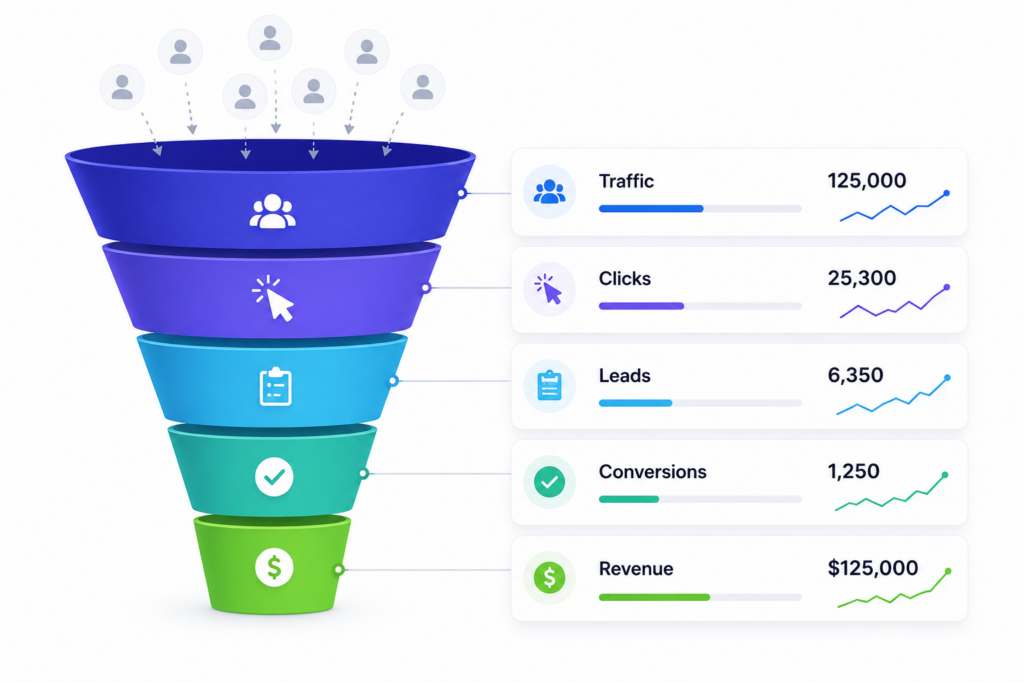
Performance marketing operates through measurable campaign structures. Businesses first define a goal, select marketing channels, launch campaigns, track user behavior, and optimize results based on collected data.
The process usually begins with audience targeting. Marketers identify ideal customer profiles using demographic data, interests, behavior signals, and purchase intent.
Next comes campaign execution. Ads, landing pages, content assets, and tracking systems work together to guide users toward specific actions.
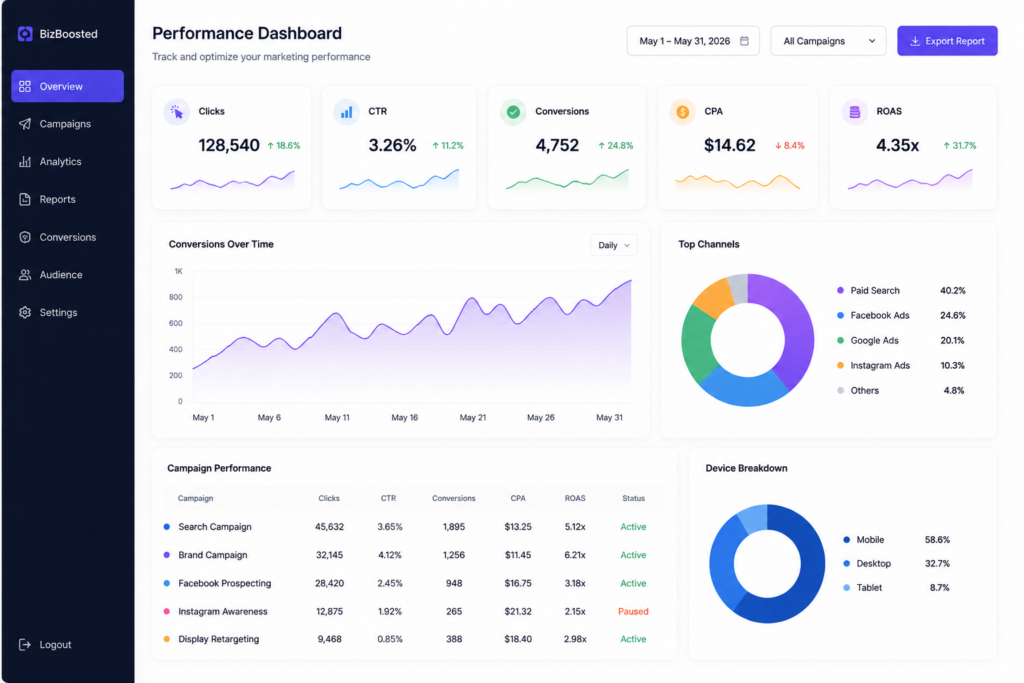
Measurement is the most important stage. Marketers analyze metrics including click-through rates, conversion rates, cost per acquisition, and return on ad spend. Insights from this data drive ongoing improvements.
Because optimization happens continuously, performance marketing becomes increasingly efficient over time and supports sustainable growth.
Performance Marketing Channels
Performance marketing works best when businesses select channels based on goals, audience behavior, and expected outcomes. Each platform supports different campaign objectives and contributes to measurable growth.
Search advertising remains one of the strongest performance channels because it captures users with existing intent. Businesses use paid search campaigns to appear when customers actively look for products or services.
Social media advertising has also become a major growth channel. Platforms allow marketers to target users based on interests, demographics, behaviors, and engagement patterns.
Content promotion supports long-term performance by combining valuable content with strategic distribution to attract qualified audiences.
Affiliate marketing continues to be a strong option for businesses looking to expand reach while maintaining cost control because payments are tied to results.
Email campaigns, remarketing, video advertising, and landing page optimization are also important parts of a modern performance marketing strategy.
Key Performance Marketing KPIs That Matter
Tracking the right metrics determines whether campaigns generate real business value. Businesses should focus on KPIs that align directly with objectives instead of measuring vanity metrics alone.
Click-Through Rate (CTR) measures how effectively campaigns attract user interest and generate engagement.
Conversion Rate tracks how many users complete a desired action after interacting with a campaign.
Cost Per Acquisition (CPA) shows how efficiently businesses acquire customers or leads.
Return on Ad Spend (ROAS) helps evaluate campaign profitability relative to advertising investment.
Customer Lifetime Value (CLV) measures the long-term revenue generated from acquired customers.
Monitoring these indicators allows marketers to identify growth opportunities and continuously improve campaign performance.
Performance Marketing vs Traditional Marketing
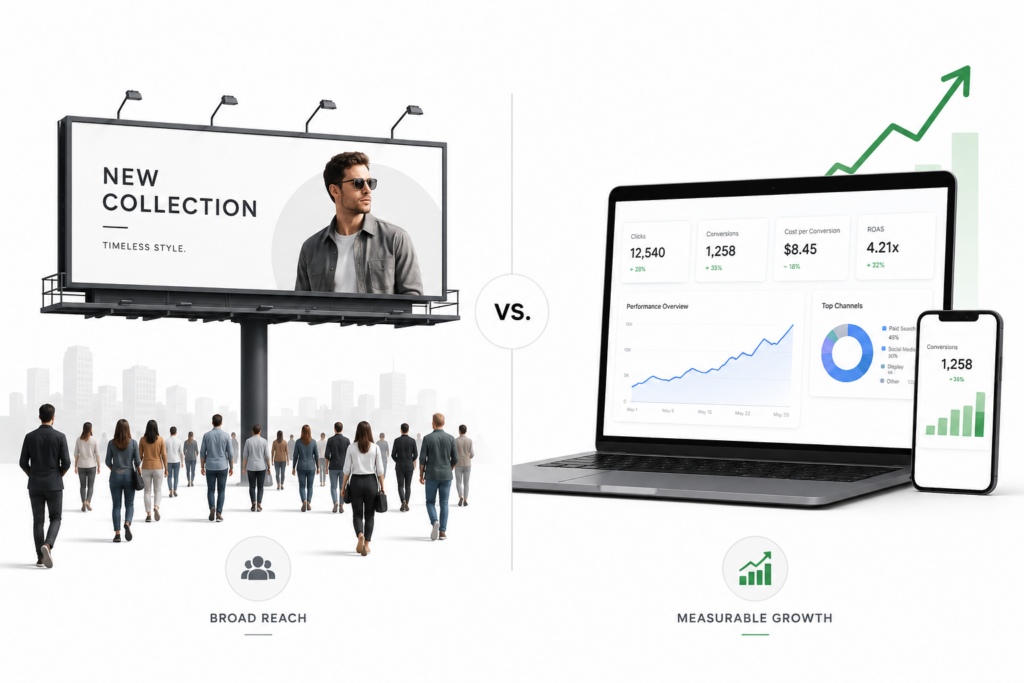
Performance marketing and traditional marketing share the same goal of business growth but operate differently.
Traditional marketing often focuses on broad visibility through channels such as television, print, radio, and general awareness campaigns. Measuring exact outcomes can be difficult because attribution is less precise.
Performance marketing focuses on measurable actions and data-driven decision-making. Every campaign is connected to outcomes such as leads, conversions, purchases, or revenue.
Traditional campaigns may deliver strong brand exposure, while performance marketing provides faster optimization cycles and clearer accountability.
For many businesses, the strongest strategy combines both approaches. Brand awareness builds recognition while performance marketing converts attention into measurable results.
Benefits of Performance Marketing
One of the biggest benefits of performance marketing is accountability. Businesses gain visibility into where budgets are being spent and which campaigns generate value.
Performance marketing also supports faster optimization because marketers can adjust campaigns using real-time performance insights.
Scalability is another major advantage. Businesses can increase investment in campaigns that perform well while reducing spending on lower-performing initiatives.
Targeting capabilities improve efficiency by helping brands reach relevant audiences instead of broad exposure.
Perhaps the most important benefit is measurable growth. Organizations can connect marketing activity directly to business outcomes and build stronger decision-making processes.
At BizBoosted, we recommend combining performance marketing with SEO and content strategies to create balanced growth systems that deliver both immediate and long-term value.
Building a Successful Performance Marketing Strategy
Understanding what is performance marketing is only the first step. Businesses also need a structured strategy to convert marketing activity into measurable outcomes. Running campaigns without a clear system often leads to wasted budget and inconsistent performance.
A strong performance marketing strategy begins with defining objectives. Some businesses aim to increase website traffic while others prioritize lead generation, purchases, or customer retention. Clear goals allow marketers to select the right channels and performance indicators.
Audience research plays an equally important role. Businesses should understand who their ideal customers are, where they spend time online, and what factors influence purchasing decisions. Campaign messaging becomes significantly more effective when built around audience intent.
Creative assets must also support conversion goals. Landing pages, ad creatives, calls to action, and user experience all influence campaign performance. Small improvements across these elements often create meaningful increases in conversion rates.
Performance marketing should not operate in isolation. Combining paid campaigns with SEO, content marketing, and analytics creates stronger long-term growth opportunities and improves overall acquisition efficiency.
How Businesses Measure ROI in Performance Marketing
One of the reasons businesses invest heavily in performance marketing is its ability to connect spend directly with outcomes. Measuring return on investment allows teams to understand which activities produce meaningful results.
ROI analysis begins with attribution. Businesses should identify which channels, campaigns, and customer interactions contribute most effectively to conversions.
Campaign profitability should also include broader business factors such as customer lifetime value, retention, and repeat purchases rather than immediate revenue alone.
Analytics tools make this process easier by providing insight into user behavior, conversion paths, and campaign efficiency. Businesses that review performance consistently make faster improvements and reduce wasted spending.
Another important practice is continuous testing. Testing different headlines, audiences, creatives, and landing pages allows businesses to improve results over time rather than relying on assumptions.
Common Performance Marketing Mistakes to Avoid
Even experienced marketers make mistakes that reduce campaign effectiveness. Recognizing these issues early can improve results and increase efficiency.
One common mistake is focusing entirely on traffic rather than conversions. Large visitor numbers do not automatically create business growth.
Another issue is weak audience targeting. Campaigns often underperform because messaging is shown to users with low purchase intent.
Many businesses also overlook landing page optimization. Driving users to poorly designed pages reduces conversion potential regardless of campaign quality.
Tracking setup errors create additional challenges. Missing conversion tracking or inaccurate attribution limits decision-making quality.
Finally, businesses sometimes prioritize short-term wins and ignore long-term growth channels. Combining performance marketing with SEO and content usually creates stronger business outcomes.
Future of Performance Marketing
Performance marketing continues evolving as customer expectations and technology change. Businesses are increasingly adopting automation, predictive analytics, and AI-supported campaign optimization.
Privacy updates are also reshaping tracking approaches. Marketers must focus more on first-party data, customer relationships, and consent-driven measurement.
AI-powered campaign management is improving audience targeting, content personalization, and budget allocation. However, strategy and human decision-making remain essential.
The future belongs to businesses that combine measurable marketing with trust, education, and sustainable growth models.
At BizBoosted, we believe performance marketing will continue moving toward integrated growth systems where paid media, SEO, analytics, and content work together to create stronger business outcomes.
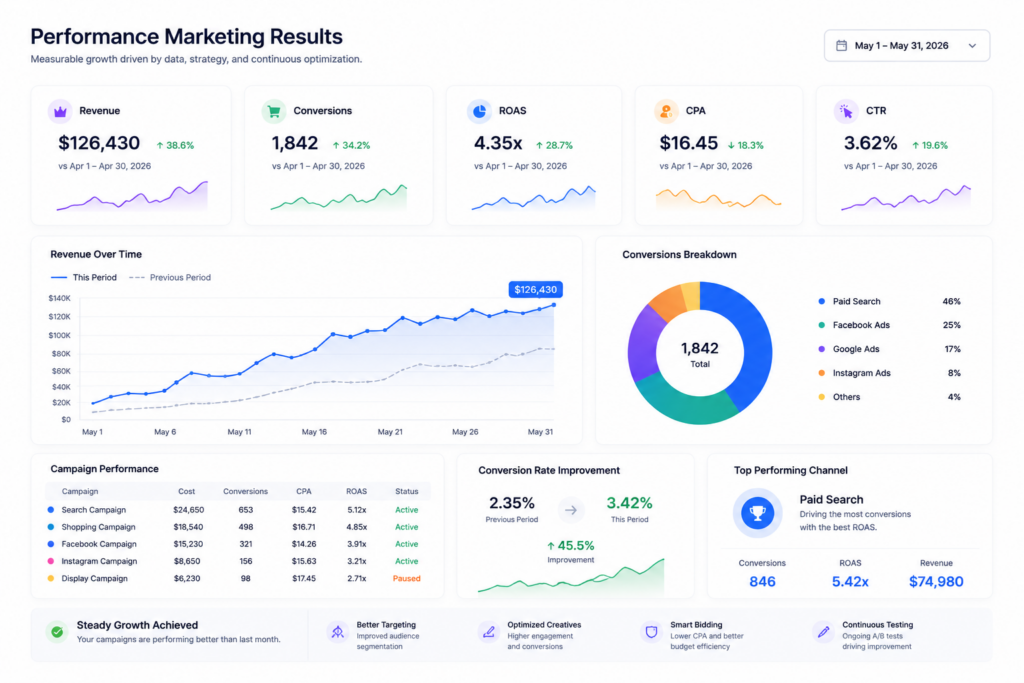
Real Examples of Performance Marketing
To understand what is performance marketing more clearly, it helps to look at how businesses apply it in real situations. Performance marketing is successful because campaigns are built around measurable business goals instead of assumptions.
For example, an eCommerce business may launch search advertising campaigns targeting users actively searching for products. Instead of measuring impressions alone, the business tracks clicks, purchases, cost per acquisition, and return on ad spend. Campaign budgets are adjusted continuously based on actual performance.
A local service business may focus on lead generation campaigns through search and social media. Success is measured using booked calls, form submissions, and qualified inquiries rather than traffic volume.
Software and SaaS companies often combine performance campaigns with educational content. Paid acquisition attracts users while blog content and email sequences nurture relationships until conversion.
These examples show that performance marketing is flexible across industries because success is connected to outcomes rather than channel selection alone.
How SEO and Performance Marketing Work Together
Many businesses mistakenly treat SEO and performance marketing as separate growth channels. In reality, combining both approaches creates stronger long-term performance.
Performance marketing generates immediate visibility and faster testing opportunities. SEO creates sustainable traffic and long-term authority. When used together, businesses reduce acquisition costs while improving conversion efficiency.
Paid campaigns can identify high-converting keywords and audience segments. Those insights can later support SEO content strategies and improve organic growth.
SEO also strengthens performance marketing results by improving landing page quality, content relevance, and user trust. Visitors who discover a business organically often convert more effectively over time.
Content marketing creates additional value by supporting both channels simultaneously. Educational resources attract traffic, improve engagement, and increase campaign effectiveness.
At BizBoosted, we recommend using SEO and performance marketing as connected growth systems rather than competing strategies. Businesses that combine measurable advertising with long-term content investment often achieve more stable and scalable growth.
Real Examples of Performance Marketing
To understand what is performance marketing more clearly, it helps to look at how businesses apply it in real situations. Performance marketing is successful because campaigns are built around measurable business goals instead of assumptions.
For example, an eCommerce business may launch search advertising campaigns targeting users actively searching for products. Instead of measuring impressions alone, the business tracks clicks, purchases, cost per acquisition, and return on ad spend. Campaign budgets are adjusted continuously based on actual performance.
A local service business may focus on lead generation campaigns through search and social media. Success is measured using booked calls, form submissions, and qualified inquiries rather than traffic volume.
Software and SaaS companies often combine performance campaigns with educational content. Paid acquisition attracts users while blog content and email sequences nurture relationships until conversion.
These examples show that performance marketing is flexible across industries because success is connected to outcomes rather than channel selection alone.
How SEO and Performance Marketing Work Together
Many businesses mistakenly treat SEO and performance marketing as separate growth channels. In reality, combining both approaches creates stronger long-term performance.
Performance marketing generates immediate visibility and faster testing opportunities. SEO creates sustainable traffic and long-term authority. When used together, businesses reduce acquisition costs while improving conversion efficiency.
Paid campaigns can identify high-converting keywords and audience segments. Those insights can later support SEO content strategies and improve organic growth.
SEO also strengthens performance marketing results by improving landing page quality, content relevance, and user trust. Visitors who discover a business organically often convert more effectively over time.
Content marketing creates additional value by supporting both channels simultaneously. Educational resources attract traffic, improve engagement, and increase campaign effectiveness.
At BizBoosted, we recommend using SEO and performance marketing as connected growth systems rather than competing strategies. Businesses that combine measurable advertising with long-term content investment often achieve more stable and scalable growth.
Why Businesses Are Investing More in Performance Marketing
Businesses across industries are increasingly asking what is performance marketing because traditional advertising alone no longer provides enough measurable insights. A clear understanding of what is performance marketing helps companies make smarter budget decisions and improve marketing efficiency.
One of the biggest advantages of understanding what is performance marketing is the ability to connect campaigns directly with business outcomes. Instead of relying only on impressions, businesses can measure clicks, leads, conversions, and revenue impact.
As digital competition grows, more organizations are adopting performance-focused strategies to improve return on investment and support long-term growth. Learning what is performance marketing allows brands to build scalable systems that combine analytics, optimization, and sustainable customer acquisition.
Businesses that understand what is performance marketing gain a stronger ability to make data-driven decisions and improve long-term growth. Rather than relying on assumptions, performance marketing allows teams to optimize campaigns based on measurable outcomes and real customer behavior. As competition increases across digital channels, learning what is performance marketing helps businesses allocate budgets more effectively, improve conversion performance, and build scalable marketing systems designed for sustainable results.
Conclusion
Understanding what is performance marketing is no longer optional for businesses competing in modern digital environments. Companies today need more than visibility—they need measurable outcomes that support growth, efficiency, and sustainable customer acquisition.
Performance marketing provides a structured way to connect campaigns with business results. By using the right channels, tracking meaningful KPIs, and continuously optimizing performance, businesses can improve marketing effectiveness and maximize return on investment.
The most successful organizations do not treat performance marketing as isolated advertising. Instead, they combine performance campaigns with SEO, content, analytics, and conversion optimization to create scalable growth engines.
As digital competition continues increasing, businesses that prioritize measurable marketing systems will be better positioned to grow faster and make smarter decisions.
FAQs
What is performance marketing?
Performance marketing is a digital marketing model where businesses pay for measurable results such as clicks, leads, or conversions.
Why is performance marketing important?
It helps businesses track results, improve ROI, and optimize campaigns using real data.
Which channels are used in performance marketing?
Common channels include search ads, social media ads, email marketing, affiliate marketing, and content promotion.
What KPI is most important?
It depends on goals, but CPA, ROAS, conversion rate, and CTR are commonly tracked.
Is performance marketing better than traditional marketing?
Performance marketing offers better measurement and optimization, while traditional marketing supports broader brand awareness.